Monday, January 12, 2015

It's Monday and a Snow Day! Here's What I Read...

Jen Vincent at Teach Mentor Texts and Kellee Moye and Ricki Ginsburg at Unleashing Readers cohost It's Monday! What are You Reading? weekly on their blogs.  To see what others are reading and recommending each Monday, or to participate, be sure to head over to these blogs.


We had a snow day here in Connecticut (which was really a rain day, but that's another story), and I was able to spend some time at the local book store reading some of the newer picture books on the shelves.


So many examples of end punctuation!
One of my favorites of the day was Goodnight Already!  by Jory John and Benji Davis. I could easily see using this as a mentor text in a writing workshop to illustrate conflict, different types of beginnings and endings, as well as several convention moves. On one particular page, there are several examples of periods, question marks, and exclamation marks. How fun would that be for teaching first-graders the importance of end punctuation! Goodnight Already also has several opportunities for young readers to talk about "what else" is happening on the page, even a couple of pages without any words.

We always have to read a Mo Willems book, and today we read A Big Guy Took My Ball. If you have not read this one, find it and read it. Soon. All of the Elephant and Piggie books have messages for living, but I especially liked this one because it was so much about empathy and perspective. A big ball to a pig is not a big ball to a whale. Also, in our competitive world, it's good to talk about the fact that we can usually find people who are smarter, faster, stronger, richer, thinner...yes, Elephant, there is someone who is bigger than you.

Although I am not positive how I would link A Perfectly Messed-Up Story by Patrick McDonnell to writing workshop, I think that young children would think that the premise of this book is hysterical. Furthermore, the message that could come out of this book is important as well, since the main character struggled so much with perfection that he froze and gave up. Don't we all sometimes?

I have a new idol and his name is Brad Meltzer. I had not seen Brad Meltzer's series about ordinary people who changed the world until today. I read his book, I am Rosa Parks. Told as a personal narrative, Brad Meltzer weaves in many facts and details through Rosa's voice. In addition to Rosa Parks, he has written others from the points of view of Albert Einstein, Jackie Robinson, Abraham Lincoln, Amelia Earhart, and Lucille Ball. With not only the narrative, but also the graphic representations and speech bubbles, readers will come away with so much knowledge about the person and time period! In addition to the body of the text, there is also a section in the back with photographs, archived information, and additional resources. For anyone with a biography unit, I highly recommend these for middle to upper elementary students.

Over the rest of the week, the majority of my reading time has gone to my on-line writing group. I am so grateful to these people for having the courage to share their writing and critique mine. Some day, I hope to write about their books with a link to Amazon!

Happy Reading!


Tuesday, January 6, 2015

Slice of Life- Exploring a fabulous mentor text

Thanks to Stacey, Dana, Tara, Betsy, Anna, and Beth, the amazing writers and thinkers who host the Slice of Life community every Tuesday. Everyone is welcome to join with posts or comments at twowritingteachers.wordpress.com!


Our fourth-graders are getting ready to start their information writing unit. Instead of a classic writing workshop lesson, I co-taught a lesson today where their teacher read them one of my favorite mentor texts, It's All About Me-ow by Hudson Talbott, and I wrote down what I noticed that the author did as an information writer.

As the classroom teacher read, I jotted down what I noticed about the book, but I purposely stayed just behind the teacher as he read. That way, some of the students felt like they "noticed" first, while some of them "noticed" because I did. Either way, every student was engaged and they all have a list of craft moves  in their writer's notebooks that they are excited to try in their own information books.

I did not expect to notice over twenty-five craft moves, or I might have written smaller:


That being said, I think that it's really important that we don't obsess with having perfect charts. I loved the fact that the entire left-hand column is added because of what the students noticed and I missed. They were so proud of themselves!


I highly recommend Hudson Talbott's book as a mentor text for information writing because he does such an amazing job of including information with humor, voice, figurative language, and text features. The students loved the story and the craft moves--I can't wait to see what they write!

As new units begin, I also recommend having this sort of inquiry with any unit at any grade level. Read an appropriate level mentor text, especially one that the class has already read. Talk about the craft moves, the impact, the reasons that the writing piece works.  This chart, admittedly messy but created together, will serve the students well throughout their unit as a source of inspiration for their own information pieces.

Happy Slicing!


Sunday, January 4, 2015

It's Monday! Here's What I'm Reading...


Jen Vincent at Teach Mentor Texts and Kellee Moye and Ricki Ginsburg at Unleashing Readers cohost It's Monday! What are You Reading? weekly on their blogs.  To see what others are reading and recommending each Monday, or to participate, be sure to head over to these blogs.

While a lot of my reading time was dedicated to reading the work of my writing group, as well as rereading and revising my own work, vacation offered enough time to also read some wonderful new books.

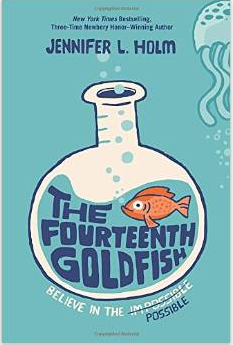
The Fourteenth Goldfish by Jennifer Holm reminds me of a contemporary Tuck Everlasting,  and that is a huge compliment. With humor, memorable characters, and a fast-moving plot, Jennifer Holm imparts a powerful message about immortality and the importance of learning for the sake of learning, while weaving in lots of scientific information.

Nest by Esther Ehrlich is a beautifully written story, but warning: it is agonizingly sad! The main character, Naomi, has more to deal with than any eleven year-old should have, ever! Set on Cape Cod in the 1970's, she has to deal with a mother with a serious disease and ensuing depression, religious discrimination, an over-analyzing father, and a struggling older sister. There are infinite passages throughout this book that serve as mentors for establishing plot, tension, character turning points, and inner turmoil. Just be prepared for some vivid memories of life in the 70's and some incredible tear-jerking scenes!

Grammar instruction remains at the forefront of some of my work for this year, and I highly recommend Grammar Matters by Lynne R. Dorfman and Diane Dougherty. This book is full of explicit teaching points, specific references to mentor texts, connections to standards, examples of student work, and anecdotes from model classrooms. Furthermore, the teaching points and lessons are written in workshop format and structured within specific units for specific grades. With extensive appendices, this is an incredible resource for aligning workshop instruction with the Language Standards of the Common Core.

Happy reading!

Thursday, January 1, 2015

My One Little Word for 2015: Acknowledge

I had not planned to take a blogging break over the holidays, but family, parties, and an overabundance of distractions got in my blogging way. I have been reading posts though, and watching people debate and decide on their one little words for 2015.

I have never been good at making and sticking to resolutions. (Full disclaimer: I've been better and making them than sticking to them.) However, for the last two years, I have committed to One Little Word. I wish I knew who to give credit to for this idea. The concept is simple; decide on a word that will help you, guide you, inspire you, make you a better person, help you achieve your goals...just one little word.

My #OLW for 2013 was present. All year long, that one word inspired me to play more attention to the world around me. I still return to that word when I begin to feel unsettled. Last year, for 2014, my #OLW was kindness. I have four daughters. I'm six months away from having four teenage daughters. Kindness was an important word for me to remember, as there were several days when our house needed large doses of it. (If only I could get them to choose one little word and have it be kindness!) I'm thinking that words can accumulate over the years, as I don't plan to forget about how remembering my words helped me to be a better mother, wife, friend, and person over the years.

So now for 2015... I've talked about my word over the last few days, wondering out loud to my family about some of the contenders. For 2015, my one little word will be:
I am choosing this word because my life has been feeling so rushed and I forget to let people know how much I admire them, worry about them, care about them, appreciate them, love them. I want to do better at acknowledging the love, achievements, and struggles of people in my life--both my personal and professional worlds.  

For today, I am not going to share the runner-ups. Maybe I will use one of them in 2016. For today, I am excited to move into 2016 remembering my previous words--present and kindness--and working on my 2015 OLW, acknowledge. 

Happy New Year to all of you, and thank you for all of the comments, support, and wisdom you have given me in this amazing blogging world. 


Monday, December 15, 2014

Finding Some Creative Ways to End Information Writing Pieces

Thanks to Stacey, Dana, Tara, Betsy, Anna, and Beth, the amazing writers and thinkers who host the Slice of Life community every Tuesday. Everyone is welcome to join with posts or comments at twowritingteachers.wordpress.com!

Over the past couple of weeks, I have been working in some of our third grade classrooms as they have been working their way through our information writing unit. We wanted to try some different techniques for students to try out as endings. Yesterday, I shared some of the titles that we used as mentor texts as an It's Monday! What Are You Reading post, but I also taught the lesson with one of the teachers.

We planned the lesson as an inquiry, so we began with a chart that needed filling out. As the students studied the collection of books I had gathered from our library, they began to realize some of the different and creative ways that nonfiction writers sometimes use as endings.


I had way too much to get on to that chart fast! Tomorrow, I will photocopy some of the pages and include those on the chart, as well. The students surpassed my expectations of what they would find! My chart isn't as picture perfect as I would have liked, but charts don't have to be, and the kids loved the quest for different endings!

Nicola Davies used the circular ending in two of the books we studied, one of my favorite ending techniques. I highly recommend checking out her books, Surprising Sharks and Big Blue Whale. These are NOT your typical fact-oriented books and her endings are super fun!

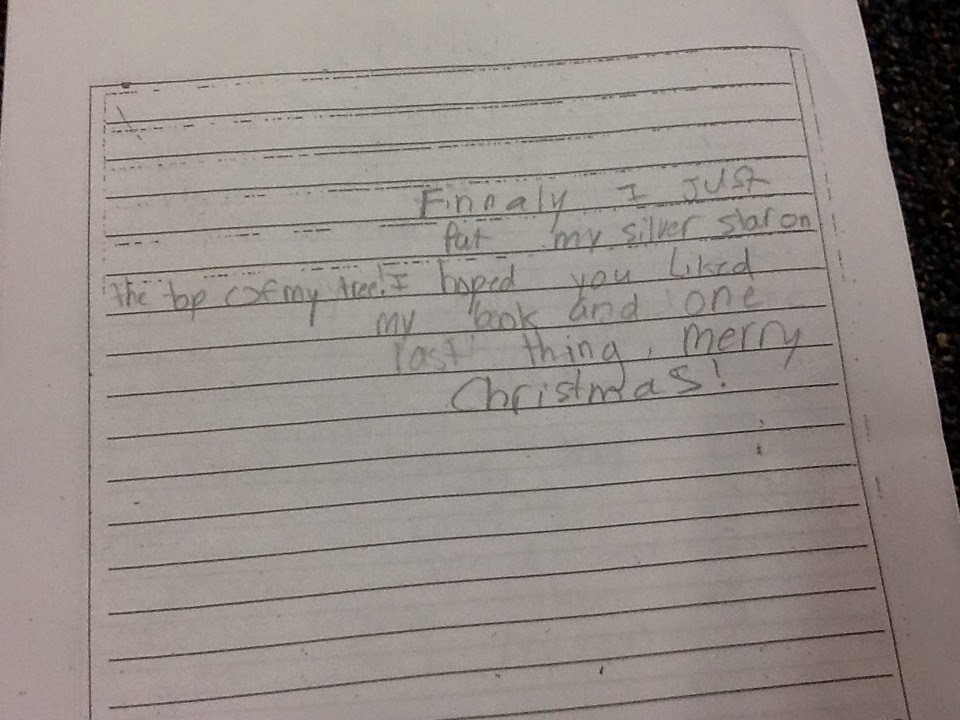
Then came my favorite part of our writing workshop because the students tried out different sorts of endings. One girl wrote about Christmas decorating and began her piece with the bare tree in the hallway, ending with the star on the top. In between, she wrote all about the decorations in her house.


Finally, I just put my silver star on the top of my tree. I hope you liked my book and one more thing--Merry Christmas!
 Another boy tried out the "imagine" technique:
Imagine TH School with no gym, no exercise, and only lazy people. Well, that's what it'll be like with no gym.
As you can see from the chart and the growing collection of names on the "Who has tried it?" column, many more students experimented with more playful endings, inspired by a collection of mentor texts and my favorites nonfiction inspiration, Georgia Heard's Finding the Heart of Nonfiction.

Happy slicing, writing, and teaching!


It's Monday! Here's What I'm Reading...


Jen Vincent at Teach Mentor Texts and Kellee Moye and Ricki Ginsburg at Unleashing Readers cohost It's Monday! What are You Reading? weekly on their blogs.  To see what others are reading and recommending each Monday, or to participate, be sure to head over to these blogs.

Some of the third-grade teachers have been asking me about endings for nonfiction writing pieces. Inspired by the post about endings from Clare and Tammy, as well as how Georgia Heard writes about endings in The Heart of Nonfiction, I gathered up some nonfiction mentor books with different endings.

Surprising Sharks by Nicola Davies is a wonderful example of a circular ending. She begins the book with the fear that humans have when they hear that a shark is in the water, but ends with the fear that sharks have when they hear that humans are in the water. Nicola Davies also wrote Big Blue Whale,demonstrating another way to have a circular ending. 

The students loved looking at Stay: the True Story of Ten Dogs by Michaela Muntean and loved the ending in this book, as well. Michaela Muntean closes the book with a powerful quote from the owner of the dogs about the importance of his animals in his life. 

What's in the Pond and What's Under the Log, both by Anne Hunter demonstrated how writers can leave readers with a responsibility. Anne Hunter talks to her readers, reminding them to take care of ponds and remember to replace logs in order to take care of the animals that live in those worlds. 

Another set of students examined Three Days on a River in a Red Canoe by Vera Williams and found that writers can also end information pieces with a thought or an image at the end of the day. They loved trying out this technique in their own writing. 

We found some other ways to end our work by looking at other books in the room. This work inspired the students to not only read closely, but also to provide creative sense of closure for their own writing. So fun!

Happy reading and writing!


, 

Saturday, December 13, 2014

Anchor Charts for Conventions

Last year, I worked with one of the teachers in our district on how to teach conventions to students so that they would not only retain the skills, but also use the skills in their writing. Together, we created a chart during an inquiry lesson that specified all of the conventions that her fourth graders knew. That chart held her students accountable for those skills whenever they wrote, and the skills on that chart were aligned to the Common Core State Standards.

Because her students did so well on both our district's editing and revising assessments as well as the conventions component of our district's analytic rubric, I have created a set of master charts for grades 1-5 that I am sharing. These charts align to grade level standards and increase in expectations going up the grades. Since these charts are cumulative, you wouldn't want to be a fifth-grade teacher if students haven't mastered the previous grade level standards!


My hope is that these charts serve as anchor charts for conventions within classrooms. They can be introduced during writing workshop with the important teaching point that writers pay attention and use conventions in order to make sure that readers can understand their writing.  I also am creating smaller versions that can serve as toolkits for students to keep in writing folders or within notebooks. Depending on how teachers roll out the lesson, perhaps students' initials may appear on the charts in order to increase accountability and designate "classroom experts."

So one of the CCSS language standards is addressed within out curriculum. Now, on to parts of speech and grammar... If anyone out there has done work around integrating some of the grammar standards into workshop practices and writing units, I would love to hear about it. 

Happy writing (and punctuating!),


Tuesday, December 9, 2014

Slice of Life: Wondering about a Capitalization Rule

Thanks to Stacey, Dana, Tara, Betsy, Anna, and Beth, the amazing writers and thinkers who host the Slice of Life community every Tuesday. Everyone is welcome to join with posts or comments at twowritingteachers.wordpress.com!


My morning slice is more about wondering than about capitalization, but I'd love to hear who is an expert on dog breed capitalization. A classroom moment sent me wondering!

Yesterday, I taught a lesson for third-graders where I asked them to read a mentor information writing piece from Writing Pathways by Lucy Calkins. Many of you may be familiar with this resource and with the series of pieces about bulldogs. (If not, this is a must-have resource for writing workshop teachers! Worth the money for the checklists alone!!!) One close reader/editor noticed inconsistencies in the capitalization of bulldog. He was absolutely right! In some instances, bulldog was capitalized and in other instances it wasn't.

I thought that I was an expert on capitalization. In the moment, the other teachers who were in the room and I said that bulldog should be capitalized. (It shouldn't be. We were wrong...) This morning, I asked my husband about dog breeds and capitalization, mostly because before I wrote about not knowing the right answer, I wanted to see how silly I might look in front of my slicing community. (Garth is a pretty good editor.)

"Yes," he said. "Dog breeds are capitalized."

"Cocker spaniel?" I asked?

"I think so. But wait, cocker isn't really a place. I'm not sure."

"Poodle?" I pressed.

"Hmmm. No, I don't think poodle," he said.

"Pug?"

"Not sure. American pug is, though."

"The A and the P? Or just the A?"

"You got me," he admitted. "I'm not sure."

 This morning, I looked it up. Here are some of the on-line responses:

From AP Style Rules at a Glance:

Animals: Capitalize names of specific animals: The dog’s name is Rover. The veterinarian could not save Snowflake. For breeds, follow Webster’s. Capitalize words derived from proper nouns: Boston terrier, German shepherd.

3. Should names of dog breeds be capitalized — for example, pomeranian, labrador, “bull terrier,” “American pit bull terrier”?
Dog breeds are not capitalized unless the name is that of a geographic region: Pomeranian, “Labrador retriever,” “bull terrier”, “American pit bull terrier.” (Dalmatian is an exception; it’s usually lowercase, but I would probably uppercase it when it appears with similar names normally capitalized.)

I will definitely return to this class and these teachers to tell them about my learning. While I would love for them to use correct capitalization every single time, what I really want them to celebrate is the wonder that this young editor inspired. Sometimes, we don't know all the answers, but we can ask questions and we have places and references to consult. Also, sometimes even teachers are wrong, but we can circle back and correct our mistakes.

Hmmm. Life lesson?

Happy Slicing,


Monday, December 8, 2014

It's Monday! What Are You Reading?

Jen Vincent at Teach Mentor Texts and Kellee Moye and Ricki Ginsburg at Unleashing Readers cohost It's Monday! What are You Reading? weekly on their blogs.  To see what others are reading and recommending each Monday, or to participate, be sure to head over to these blogs.

 The Paper Cowboy by Kristin Levine is one of my new favorite books. Although the story takes place in a small midwestern town during McCarthyism, the themes are universal. I love Kristin Levine's final message in her author's note about the importance of community. She writes, "the old woman who lives next door might need some company. The annoying boy on the playground might be longing for a friend. Even when a parent is sick or a child is injured, it's not always easy to see the need or what to do about it. But when people do step in and help, when they take a chance and engage with their neighbors, amazing things can happen." Tommy, the narrator, is a character you won't soon forget, as he deals with guilt, abuse, dysfunctional family relationships, and a community reeling with fear. He is a bully and there were times when I wanted to jump into the pages and shake him, but his reflections and honesty about his actions could lead to some powerful conversations about the complexities of bullying. Kristin Levine had me hooked in the first chapter, and my Christmas decorating was put off in favor of reading a great book.

The Book With No Pictures by B.J. Novak had me and my teenage daughters laughing out loud because of the silly language.  While I love picture books with no words because they challenge readers to make up the stories, I LOVE this book with no pictures because it invites visualization. Once the silliness and interactiveness of this book is fully experienced, I would love to challenge young readers to imagine the pictures that they would put on the pages. If anyone has done this, please share!


If I thought that we were laughing hard in the bookstore over The Book With No Pictures, it was nothing compared to Waiting is Not Easy by Mo Willems. My teenage daughters had not read any of the Mo Willems books before and we left the bookstore with one and a promise to bring more home from the library.  The pictures are hilarious, but the final message is brilliant. I am not going to tell you what Piggie has in store for Elephant. Pick this one up and read it together with a favorite book buddy. You won't be disappointed!


Happy Reading!

Tuesday, December 2, 2014

Just Five Minutes. Getting the Family to Write.


Thanks to Stacey, Dana, Tara, Betsy, Anna, and Beth, the amazing writers and thinkers who host the Slice of Life community every Tuesday. Everyone is welcome to join with posts or comments at twowritingteachers.wordpress.com!

One of the sessions that I attended at NCTE14 was about writing college essays. Full disclosure: this was my selfish session. I did not go as a professional; I went as a mother of a high school junior and a high school sophomore. I was curious to hear what college admissions professionals would have to say about college essays.

Rebecca Joseph, Valerie Gregory, and Evan Read offered some great tips for college essay writers, but one of the most important take-aways for me had to do with journal writing. Every. Day. For just five minutes, but every day. A collection of moments.

This was an easy sell for me. I'm our district's writing coordinator. I love to teach writing. I love to write. I could get my family writing.  I would get my family writing...

When I got home on Sunday, we went journal shopping. For the family members (we have a lot of family members) who weren't there, we chose for them. (I came home from NCTE with an inspirational journal which was my literary gift from Stacey!) Almost every night since, we have finished dinner by writing for five minutes. Of the three daughter who are still home, two of them are more compliant than one of them. My husband knew well enough to go along. My mother went along, and even my dad, who has significant dementia, has taken up writing every night. We all have the option to share or not to share.

Here are some results:

  • My youngest daughter, who is 12, has written several stories in her new notebook. Her writing life in school has been pretty non-existent, so she is thrilled to have time and an audience. She has noticed things during the days that she may not have and written about them in the longer than five minute writing sessions that we have kept up for eight days. (We took Thanksgiving off.)
  • My 15 year-old daughter has started a novel. Her sessions have evolved into chapter writing and we all look forward to the nightly updates on her characters who are stuck at sea. 
  • My husband has written about some of his worries that none of us realized were worries until he shared. 
  • My mother has gotten us all laughing with some of her recounts of family moments.
  • My father has written psalms and songs and some of the connections that he has to them. 
  • Even Julia, the chief resister at age 16, has written some poems and some commentaries about the absurdities of high school life. 
  • I have a collection of vignettes, some of which I have realized would fit into the book I am working on, adding needed levity. 
We have lingered at the dinner table, since many of the entries lead to more stories and connections. Even my father has lasted in the conversations. Even Julia, who is always in a hurry to get to her homework, has found herself sticking around and laughing with us. 

I have worked hard to keep the time limited to about five minutes, but sometimes people keep writing while others are sharing. We have unofficially decided that this is okay. No rules seems to be working as the rules. No one has to share. No one has to stop writing. No one even has to keep writing when they feel done. 

I recommend writing together as a family--not to come up with the best college essay, but to share silly moments and special times. We have found that we talk much more than we write as a result of our latest ritual. Hopefully, this one will have some staying power!

Happy Writing!


Monday, December 1, 2014

It's Monday! I'm Reading Books about Grammar Instruction


Jen Vincent at Teach Mentor Texts and Kellee Moye and Ricki Ginsburg at Unleashing Readers cohost It's Monday! What are You Reading? weekly on their blogs.  To see what others are reading and recommending each Monday, or to participate, be sure to head over to these blogs.

I have had a somewhat nerdy weekend and have spent time reading several of the books that I have either recently purchased or found in my professional bookshelf about grammar. The Language Standards of the Common Core are my next big challenge. In our district, we are working hard to figure out the balance of meaningful grammar and conventions instruction with drill and kill saturation. I have to say, there are some really good books and I am sharing my weekend sampling.


Mary Ehrenworth and Vicki Vinton wrote The Power of Grammar in 2005, and the lessons still align with the Common Core. They envision a workshop based series of units with integrated teaching points about specific convention and grammar skills. For example, "writers make choices about ending punctuation" would be a lesson during a narrative unit, while comma usage and verb agreement would be lessons that would occur in later units. 
Their message that "grammar is intimately linked with power" (p. 4) resonates throughout the entire book. I love the idea of emphasizing power to children when teaching grammar!

The Common Core Grammar Toolkit by Sean Ruday is full of lessons and specific mentor texts for teaching explicit standards and skills. This book is divided into grade-specific sections, focusing on the skills that students are expected to master. With many examples of charts, teaching points, inquiries, and classroom snapshots, this book could inspire experienced and novice teachers with ways to integrate grammar instruction into a writing workshop. 

Constance Weaver's The Grammar Planbook has many, many pages to mark and use as references. One of my favorite quotes in her book is "when it comes to grammar and mechanics, we can't teach it all without deluging students with so much information they remember nothing." (p. 31-32) On these same pages, there is a list of the twenty errors most commonly marked by college teachers, including several comma usage errors, several pronoun-related errors, and several sentencing issues. With mentor texts and explicit lessons, this book is an excellent resource for teaching grammar and conventions in the upper elementary grades and up. 

I am looking forward to exploring Grammar Matters by Lynne Dorfman and Diane Dougherty, as well as some of the work of Janet Angelillo. 

I did read several picture books this week, as well, but those I will share next week. If anyone out there has favorite grammar books or resources, please share!

Happy reading!

Sunday, November 30, 2014

NCTE14 Reflections: It's Not Just for the Kids: Stories of what can happen when teachers embrace curiosity, openness, creativity, and wonder in the teaching of reading

Another one of my favorite sessions from NCTE14 was a panel presentation of Vicki Vinton, Fran McVeigh, Steve Peterson, Mary Lee Hahn, and Julieanne Harmatz.


All of these presenters keep incredible blogs and I recommend following them. They are reflective, inspiring teachers, worthy of great admiration!

Vicki started the group off, introducing them. These people had not met before in person. Their connections are testimony to the power of of on-line PLN's. (We are all so lucky to live and teach during a time when we can connect with so many like-minded people.) Two comments from Vicki that resonated with me are:
"If we are not constantly asking ourselves what are the kids learning, then we're not being teachers."
And, from Donald Graves:
"The teacher is the chief learner in the classroom."

Fran's portion of the presentation challenged us to think about how much we support wondering in our classrooms. In a powerful pair of slides, she showed what teachers had "known" and "wondered" when studying two pages from the picture book, Boom, Snot, Twitty by Doreen Cronin, and then what third-grade students had "known" and "wondered" from the same pages. Her message was a strong one about supporting, allowing, fostering, and celebrating wondering in classrooms, asking the powerful and important questions:
"Is reading about listing facts or creating understanding? What is our goal in reading?"
If you ever are passing through Iowa, try to make a PD session from Fran. You won't be disappointed. Hopefully, we will get her to present again next year in Minneapolis!

When Julieanne took over, she focused on the importance of read alouds, even (no, especially!) in upper elementary classrooms. Julianne has done a lot of reflective work with her students, asking them not only whether they enjoy read aloud, but also about why they enjoy it.  Most kids reported that their understanding was higher in read aloud because of the:
  • envisionment that they are able to do
  • building of word knowledge
  • opportunities to write about reading
  • sound of their teacher's voice bringing the story to life
  • opportunities to think together when you don't understand
Some of the students complained about taking too long to read a book and spending too much time talking about parts. I can definitely understand these feelings, as I am one who is known to inhale great books. However, those students can read ahead and then listen to the book a second time with no harm done. Read aloud is truly an incredible time to not only teach important reading skills, but also bond as a community that shares a literary journey. 

I loved listening to Steve Peterson talk about nonfiction reading and his quest to engage his fifth-grade students in their learning. One of his slides was the answers that he got from students when he asked them why they don't like informational text:
Kids tell such truths!
One of my favorite stories that Steve shared about the connections that kids make in his classrooms came out of a recent informational article about invasive beetles that destroy trees. Through questions and conversations, the students connected the beetles to people who invade communities and destroy other people. Wow! Steve's teaching emphasizes the fact that all information articles come from and create stories. Another important aha!!!

I would love to have any of my daughters in Steve's classroom because he is so committed to letting his students lead the learning. To experience a unit in his classroom, check out a recent post he has written about his class's weather unit. Love the concept of leading with questions, a concept that relates so beautifully to Fran's presentation about the capacity for wondering.

Mary Lee Hahn was the final presenter in this panel session, and she shared about how she has been using blogging with her students. Listening to several teachers talk about their experiences with students blogging, I'm not sure why anyone wouldn't try it out. Even the most resistant writers in her class have developed stories with voice and humor during the fifteen minutes of time she gives them every Friday. As she stated, "It's an opportunity to celebrate writing for what it is and not what it isn't!" Mary Lee had students who created series for their classmates, as well as students who explored telling stories from different perspectives and in different genres. So many, many writing possibilities! I think that the funniest (and truest) quote of the weekend was from Mary Lee when she said:
"I could write some great retroactive lesson plans!"

That being said, I'm sure that the lessons that Mary Lee writes ahead of time are great, as well!

The message from all of these presenters was so loud and clear that our classrooms should be full of inquiry and children leading the learning with questions and wonder. They have all written incredible posts refelcting on this session. You can start with Mary Lee's reflection here.  Also, continue conversations about this session with the hashtag #teacherswonder. I'm sure that they would love to see you there!