Showing posts with label questioning. Show all posts

Friday, March 25, 2016

Day 25: #SOL16-Remembering to think about how the learning feels


The Slice of Life Challenge is hosted by the inspirational writers of Two Writing Teachers. Each March, they invite people to join them in a commitment to write every day. Here's to another year of daily slicing!


Yesterday, I presented questioning strategies to a group of elementary teachers at a social studies conference. Throughout the hour long session, I had teachers do the work that I would normally have students do. When I taught them about the Question Formulation Technique, I had them do the work. I even gave them the link to my presentation and made a new slide where they could type in their questions, having the questions show up on the screen in front of everyone. When I taught them about "Ask five questions, then ask five more" I had them try it out, and when I shared a read aloud, I divided the teachers into question-asking groups the way I would for students. What I did do differently was to hit pause and ask them to take a reading on how they were feeling as learners. What was their engagement level? What was difficult? How were they feeling as learners? 

Three of my colleagues were in the session, and when we were having lunch one of them shared that those pauses had been really powerful for her. It turned into a great conversation about why it's so important for teachers to do the work we ask our students to do, really thinking about the metacognition required of the task. None of need a presenter to try out the work we ask of our students; we just need the time and the self-awareness--maybe it's self-discipline, maybe it's self-reminders, maybe I need a better word :)-- to pause and think about the metacognitive processes.  The most effective teachers I work with are the ones who not only understand the task, but also have experienced and reflected on the brainwork involved with it. 

As always--happy Slicing,


Monday, March 21, 2016

Day 22: #SOL16- Asking students to ask questions during read-aloud


The Slice of Life Challenge is hosted by the inspirational writers of Two Writing Teachers. Each March, they invite people to join them in a commitment to write every day. Here's to another year of daily slicing!


Last week, I wrote about nudging students to ask more questions by putting them in charge of asking the questions during a read aloud. Students were grouped and different groups were responsible for questions that had to do with characters, settings, figurative language, repetition, and theme development. I've been doing a lot of work around social studies, so today I tried a similar process, but instead of directing students toward reading lenses, I had them think about the text through social studies lenses. I made a chart before I read The Stranded Whale by Jane Yolen so that this class of fourth-graders were reminded of what we meant by geography, history, government, and economy. 


To be perfectly honest, I wasn't sure how the lesson would go. At one point, I apologized to the students because I was worried they'd just want to hear the story. They all reassured me that they didn't mind at all. I was extra convinced whenever I paused and gave them a chance to share the questions they were jotting down together and individually. The level of thinking was really high! Here are some of the questions these students generated, and this is only a small sampling:


Some of the students wanted to write reflections of the experience for me. I can't wait to see what they have to say. Sometimes students overwhelm and exceed even my highest expectations. 

Happy Slicing,


Wednesday, March 16, 2016

Day 17: #SOL16- Happy Question Week


The Slice of Life Challenge is hosted by the inspirational writers of Two Writing Teachers. Each March, they invite people to join them in a commitment to write every day. Here's to another year of daily slicing!


I wish I had known earlier in the month that this week is National Questioning Week. As it was, I saw something about it in a tweet on Tuesday. If anyone has interest, head over to The Right Question website. You will find tons of ideas, articles, links, and resources for incorporating more student engagement by inspiring students to ask important questions. There are videos of the Question Formulation Technique used in classrooms, and even though the featured classes are secondary ones, it's a strategy that I've used in elementary classrooms, as well. Check out some of the #questionweek tweets as well, as there are great images of charts, question scaffolds, and samples of student work. 

In honor of Question Week, I read Encounter by Jane Yolen to a group of fifth-graders, and I had them ask questions. I have to say, students listen very differently when they are generating questions. 

Happy Question Week,


Sunday, March 6, 2016

Day 7-#SOL16: Having Students Ask Questions


The Slice of Life Challenge is hosted by the inspirational writers of Two Writing Teachers. Each March, they invite people to join them in a commitment to write every day. Here's to another year of daily slicing!


Yesterday, I used a technique described during a recent Teachers College workshop. Katie Clements did a fabulous job presenting a technique to use during read aloud to engage students to ask questions as opposed to just answer questions. In a fourth grade classroom, I read Jane Yolen’s newest book, The Stranded Whale.  (Could be my new favorite!) As Katie had done with a group of teachers in New York, I had a group of students ask questions, but only through the lens of character development. Another group was responsible for asking questions that pertained to the setting. Two more groups asked questions about figurative language and repetition, while a final group listened and asked questions that dealt directly with author’s ‘message and theme. To scaffold them, I brought in a chart to give them a sense of how to formulate questions, just in case they needed it. (I think this chart could have helped Katie's audience as well, as we were pretty quiet with our questions!)


As students caught on, the engagement was super high, and the questions students asked stunned both their teacher and me. What we realized listening to them and watching them process is that for students to be able to ask the question, they probably had to be able to answer the question. That being said, some of the students brought up some sophisticated ideas. For instance, what did the whale represent to the narrator? And, what was the significance of the repetition of eye imagery?


After I left, the classroom teacher asked students to reflect in their reading notebooks about how it felt to be the question askers instead of the question answerers Here’s what fourth-grade students wrote about the process.

"Asking questions during read aloud helped me go farther into the book, farther than I ever have before.The questions made me think harder for an answer which made me think about the true meanings in the book. In short, it made me really understand the book."


When we asked students to give a thumb up or down about whether they liked this approach, almost all of the students reported liking it. The two who didn’t fascinated me with their answers: "I just wanted to hear what happened in the book," one said. "It was hard!" the other said. "I just couldn't get the hang of asking questions."

Happy reading, writing, and slicing!


Tuesday, March 1, 2016

Day 2-#SOL16: Challenging Students to Ask the Questions


The Slice of Life Challenge is hosted by the inspirational writers of Two Writing Teachers. Each March, they invite people to join them in a commitment to write every day. Here's to another year of daily slicing!


As our district's writing coordinator, I don't have a classroom of my own, so I don't always get to try out some of the new ideas I hear about in my land of professional development and inspiring conversations. I have been doing a lot of work this year about inquiry in the classroom, so I am constantly on the hunt for opportunities to get students asking questions. Today, I tried out a read aloud in a grade 3 and grade 4 classrooms where I had students ask the questions, rather than me. It was great. 

Here's a chart I shared with them to support some of them as they worked to formulate questions. I explained to them that we help out students with thinking prompts in workshop instruction, and we can also offer some support to help students become better questioners. 

I read the students Cheyenne Again by Eve Bunting which is a pretty intense picture book about a Native American boy who was taken away from his family to be educated during the late nineteenth century. Over the course of the book, I asked students to write questions--sometimes five questions, sometimes three questions, sometimes one really good one that could be used as a turn and talk. Engagement was high, maybe because the premise of the book intrigued them, maybe because I was a guest reader, but also because they loved thinking about questions. Some of the questions and wonderings were amazing and deepened by understanding and interpretation of the book. At one point, and I highly recommend this, I challenged them to pick just one of their questions and ask five more questions within that one question, really digging deeply into the wondering around that particular question. This strategy could be used for a picture, a short video clip, another read aloud, a cartoon--anything, really. The instructions, broken down simply are:

  • Write down three to five questions you are having. 
  • Choose the most interesting question.
  • Write down three to five questions that all relate to that one question. 
  • If you want an extra challenge, begin the second round of questions all with "What if?".
You will be surprised and amazed at the deep thinking that happens, and you will love the engagement levels!

Happy writing and reading!


Sunday, February 7, 2016

Thoughts on Global Competence

Last week, I got to go to Teachers College in New York City to hear Jerry Maraia's talk about global learning. Usually workshops at TC center more on reading and writing, focusing on new units of study or new trends within literacy. Jerry's lecture was more about how we can integrate the important elements of critical thinking, empathy, questioning, and taking informed action into the literacy instruction that already takes place within our classrooms.

I think that it's imperative that teachers in the 21st century have a solid understanding of what constitutes global competence. The Asian Society is a great resource, and the learners there have put forth four critical aspects of global competence. Put simply, learners should be able to:

  1. Investigate the world beyond their immediate environment, asking questions, framing significant problems, and conducting well-crafted and age-appropriate research
  2. Recognize perspectives, others’ and their own
  3. Communicate ideas effectively with diverse audiences- how we bring to the forefront the idea of how we change our presentation based on who we are talking to
  4. Take action

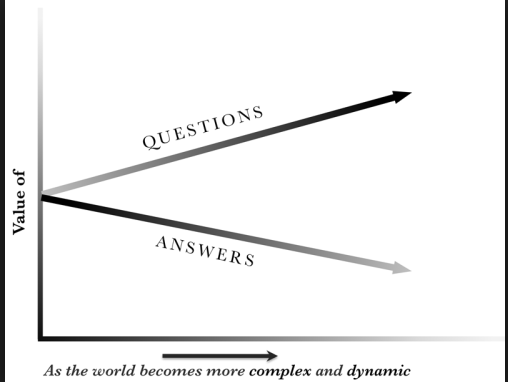
Asking questions is a skill that we frequently underestimate (and underteach!) in classrooms. Warren Berger had done amazing work around the importance of questions in today's world, and I recommend his website and his book, A More Beautiful Question. The graph below is from his website, and definitely makes the point about the increasing importance of questions in a world where information is so accessible.

Screen Shot 2016-02-04 at 10.08.31 AM.png


One of the activities that Jerry did during the morning presentation involved showing us a photograph. The picture he used was of African children doing their homework, but really, almost any picture could work. The process he had us go through was to first write down five questions about the picture. From there, we chose one of our questions and dug into that one question with five more questions, but these five new questions were to begin with "What if." The third step of this one exercise with this one picture involved beginning to think of possible answers to our questions.  It was amazing to see how many different questions and directions we all had! I can't wait to try this activity with students. It's an activity that could work in a morning meeting as well as during content areas. The important concept for me emerged out of the challenge to look closely at an image and really, really wonder about it. I want to remember Jerry's important statement that:

“We often fail to see all the possibilities available to us because we simply haven’t spent enough time looking.”


Toward the end of the presentation, Jerry offered a challenge to all of us in the room and that involved thinking about and reflecting on our own global mindedness. If we're not living with this sort of mindset, then how can we expect our students to be doing it. Choose one of the attributes of Internationally Minded Learners from the International Baccalaureate Program and think about how we can share how we're living it with our students. Here are the attributes:

Risk-taking
Inquirers
Knowledgeable
Principled
Open-minded
caring
risk-taking

These words inspire me and remind me of my responsibility to be a learner in this changing world we're all sharing.

Happy Super Bowl Sunday,


Friday, March 27, 2015

Slice #27 of 31- Inquiry in a Social Studies Classroom

For the month of March, I am participating in the Slice of Life Challenge, hosted by the community of writers at Two Writing Teachers. Many of my slices are at my personal blog, Just Write, Melanie, but ones that deal specifically with education appear here. All are welcome to join the slicing party by reading and commenting. People write amazing posts.


In the fall, we had a visit from Emily Smith, as Staff Developer from Teachers College. We were working on content area literacy with fifth-grade teachers, and Emily set up centers for students to do inquiry work around topics related to exploration. She created a timeline center, a map center, a close reading center, a compare and contrast center, and a pictures center. I duplicated this work for colonialism, and one of the teachers used the cards that we developed for the unit. Watching the students, it amazed both of us how engaging and how powerful this sort of learning is for upper elementary students.

Students had specific tasks at each center. We developed inquiry questions that were open-ended to structure their thinking. For example, when they looked at the paintings from the colonial era, what could they learn about the roles of men and women? What biases existed in the artwork, and how could they tell? Since we had five separate centers, groups of three or four students each spent fifteen minutes at the first three centers, traveling clockwise around the room. Our centers were: statistics and data, maps, timelines, architecture, and art. The conversations that happened during this activity were amazing.


They had maps and timelines that they had to analyze. Their conversations about how the maps related to the timelines were also full of realizations, reflections, and wonderings. Some of them wondered about how the maps looked so different based on only a few years. Then, when they looked at the timelines, they made some realizations about the discoveries and exploration that was happening at the time. 


At all of the centers, students took notes based on their conversations and observations. It was fun to watch the different note-taking strategies that they've been learning in the reading units reappear in their social studies work.


They also had a significant dose of math in that they analyzed data, reading graphs, interpreting tables, and thinking about percentages.


Inquiry is such a powerful way to learn. No, the students could not learn everything that there is to learn or even all of the standards around colonialism. However, they asked serious questions and they are inspired to find out more about the answers. Next week, they will finish the first round of centers, and then travel through each center a second time since their understanding deepened as they learned different concepts from each center. I'm looking forward to hearing their reflections and plans for their next round of learning!

Happy Slicing!


Thursday, February 28, 2013

Thought on Questions: Intensive-Explicit vs. Constructivism

My last post was about why we ask questions and it was inspired by many of the tweets and interactions with  #educoach participants and hosts, Jessica Johnson (@PrincipalJ), Shira Leibowitz (@shiraleibowitz), and Kathy Perret (@KathyPerret).  Over the last few Wednesday nights, they have been leading twitter chats about High Impact Instruction, Jim Knight's most recently published book.

One of the first questions that I had for Jim dealt with how many questions he would like to see teachers ask within the course of a lesson and his response to me was predictably that the answer depends on the type of lesson. Jim writes about the distinction between intensive-explicit questions and constructivist questions. Thinking back to my previous post about why teachers ask questions, the way that teachers should use these questioning techniques is dramatically different depending on the type of lesson that they are giving.

One of Jim Knight's favorite thinking prompts is one where Mo Cheeks, a basketball coach, helps a young girl as she struggles to remember the words of the National Anthem before a televised game. If I think about this prompt in an intensive-explicit way, I could use this prompt to teach about a story with the following questions:

  • What is the scene?
  • Who are the characters?
  • What is the problem?
  • How is the problem resolved?
Funny, how I would have said that these are open-ended questions until reading Jim Knight's chapter on Effective Questioning. The truth is that all of these question have finite responses and arguably, they even have right and wrong answers. I have tried to stay away from closed-ended questions, but in this case, I think that this lesson and these questions would provide an effective and engaging lesson. To answer my original question about how many questions this lesson would contain, I would think that it would contain at least four and probably more.

So could I think about this lesson from a constructivist's point of view?* What if I asked students to think about the elements of a story? I could assume that they know the four elements from above, but I could also give a quick mini-lesson about them, even presenting or creating a chart so that the students would have a tool of independence. Then, I could ask:
  • How does this story contain these story elements?
If I asked only this one question, I wonder how the students would manage. Would this one question be enough to keep them on task and engaged? I'm thinking that it would. It occurs to me that this is a powerful way to differentiate a lesson. If I were to take the constructivist approach, then my higher students could independently develop responses about the scene, characters, problem, and resolution. I could scaffold other students by taking a more intensive-explicit approach and guiding them through the questions.

If anyone tries this lesson, I would love to hear about it. I would also love to hear about lessons that combine an intensive-explicit approach with constructivism.

*I am not claiming ownership of this idea because I read it in an article that I read recently, written by, I believe, Jim Knight. A commercial served as the basis for an intensive-explicit lesson on the components of a story, but also as a constructivist lesson about what the creators of the commercial did do make it persuasive. With the availability of so much information via tweets, posts, wikis, books and articles, I can't remember where I read this idea so that I can properly reference it. If anyone knows, please share so that I can not only cite the source, but also give a shout out to creative ways of embedding media into lessons.

Be well!

Melanie Meehan


Friday, February 22, 2013

Thoughts on Questions: So, Why Do You Ask?

On Wednesday nights, I look forward to #educoach, a weekly twitterchat that is hosted by Jessica Johnson (@PrincipalJ), Shira Leibowitz (@shiraleibowitz), and Kathy Perret (@KathyPerret). For the last three weeks, these leaders have dedicated the hour to discussing Jim Knight's new book, High-Impact Instruction. While I have been interested in questioning and inquiry-based learning throughout my teaching (and parenting) career, this book and these discussions have inspired me to think more about the importance and power of questions in and out of the classroom. This is the first in a series that I will be writing about questions.

Last year, as a Special Education teacher and this year, as a coach, I find myself as a guest in many classrooms and I  pay attention to the questions posed during lessons and conferences. I have paid attention to open/closed questions, rates of questioning, who answers questions, and how successfully questions engage learners. One teacher asked me to keep data on whether she called on boys or girls more frequently. Another teacher wanted me to pay attention to who spoke more in a conference and it related directly to her questioning techniques.

Every chapter of High-Impact Learning has been high-impact reading for me, and the chapter on Effective Questions is no exception. While I know that I have thought about the reasons for questions before, I don't know that I have ever really, really analyzed the reasons for questions and I think that knowing why we ask questions leads to powerful instruction.

So, why do you ask???

  • To assess understanding
    • Within the classrooms that I visit, these are probably the most common types. Usually, they are closed-ended, meaning (and I thank Jim Knight for this concise definition) that there are a finite number of responses. Mostly, these questions result in several raised hands. Some recent examples I have heard are:
      • Which is the numerator, the top or the bottom number?
      • Who are the main characters in the book?
      • What are the parts of an introduction?
    • If they are open-ended, these questions still have an expected correct answer--teacher knows the answer and is making sure that the students do, as well.
      • What are some thinking stems?
      • How can we tell that a fraction is greater than one?
      • What were some of the reasons for the Revolutionary War?

  • To re-engage (or just engage) a student in a lesson
    • This type of question is for the student who seems to not be paying attention. When I was in middle school, I had a teacher who would throw erasers at students in space. Since he would probably find himself in trouble now and erasers no longer exist, he could use some questions to provide gravity for wandering minds. I usually don't like these sorts of questions because they have such high potential for embarrassing students, so if you are going to use them at all, I would recommend cueing the students. (Johnny, get ready. I am going to ask you the next question...)

  • To engage students in conversation
    • When a teacher uses a "turn and talk" strategy, I love to see questions that inspire students to want to have a conversation and share their thinking. 
      • Why do you think the character behaved in a certain way?
      • What do you think will happen during this experiment?

  • To challenge students to reflect on their own learning
    • I think that the more that we can inspire students to think about their learning and the reasons for it, the higher the levels of thinking students will achieve. When we ask reflection questions, I think that we have to make sure that we are really asking reflection questions and not questions that we already know the answer to; there is a place for those types of questions, but, to me, then they are more of the check for understanding sort of questions...
      • How have you used a specific strategy that we have learned in the classroom?
      • What generalizations are you able to make based on your results?
I am sure that there are other reasons for asking questions. We can draw attention to what we want to have done (Clare, did you make your bed?), we can gain necessary information (Where do we find the best pizza in town?) or we can orient ourselves for necessary next steps (what was the last step you completed in this recipe?). Within a classroom setting, I will be paying more explicit attention as to why we ask questions and I would welcome thoughts and comments about this.

Be well,
Melanie Meehan

Friday, August 24, 2012

Thoughts on the First Few Weeks

Our school starts next week and yesterday, I spent some time with new teachers reviewing curriculum and workshop teaching. Our district runs a three day new teacher orientation where new teachers receive information on everything from curriculum to benefits to union information. Their agenda is huge and it is all  important and since they probably weren't sufficiently overwhelmed (I'm joking...), here are a few more additions:


  • Have some go-to phrases for academic management. "What did you notice?" is a powerful phrase to get students thinking about the process. You can learn a lot about their thinking when they talk about what they notice. "Say more about that" is another one that works well when you want to push students' thinking.
  • Have some go-to phrases for classroom and behavior management. I have always liked providing information--if Katy is talking when she is supposed to be listening, often times saying "Katy, you're talking" is enough to make the talking stop. I loved a recent post by Ruth Ayres where the go-to line was "What are you hoping to get from this behavior?" This post is a powerful one to read and think about! 
  • Know how you want your classroom to look. It may not look that way in the first few weeks but have a vision and steer in that direction. This is the bullet under which I would say put the energy into establishing routines and systems for everything--unpacking bags, lining up, sharpening pencils, using bookmarks, putting tops back on markers.  This is also the bullet where I would say that less is frequently more during this time of year and there is the law of diminishing returns. Learning is exhausting and your students (and you) have a lot to figure out. Pay attention to the glazed over faces if they show up in your room and allow for some quiet time.
  • Know the difference between an open-ended question and a closed-ended question and work hard to use open-ended ones in your teaching. How do you think the character was feeling? will give you much more information than Do you think Jake is angry?
  • Establish a mentor who you trust--someone with whom you can wonder, analyze, wonder again, re-analyze... And have those wonderings be more than just wondering where to get more chart paper. Establish a relationship where you can wonder about the work you are doing with students and process what's working, what's not working and why so that you can make some intentional changes.
  • The amount of information and resources for teachers is infinite. Between district curriculum, the internet, twitter, pinterest, blogs, and more, there are millions of free ways to supplement your teaching. Know where you can go for information and ideas but don't try to do it all at once. Just as your students need time to integrate knowledge, routines, and information, so do you. Take time to eat and exercise and honor your personal relationships. Don't under-estimate the importance of personal happiness and joy in your teaching.

Haim G. Ginott

Haim Ginott's quote hung on my bulletin board in my first classroom.

“I’ve come to a frightening conclusion that I am the decisive element in the classroom. It’s my personal approach that creates the climate. It’s my daily mood that makes the weather. As a teacher, I possess a tremendous power to make a child’s life miserable or joyous. I can be a tool of torture or an instrument of inspiration. I can humiliate or heal. In all situations, it is my response that decides whether a crisis will be escalated or de-escalated and a child humanized or dehumanized.”

So true, isn't it?

Enjoy your first weeks of teaching. Your work is so important.

Oh! And as always--if anyone out there have other bullets to add, please share them!


Sunday, March 11, 2012

Turn and Talks in the Classroom - Part 2


Turn and Talk 2:

In an earlier post, I talked about questions that lend themselves well to turn and talks. As the Special Education teacher in the room, I pay extra attention to the children on my caseload who frequently have issues with processing speed or organizational challenges. These students benefit from having a little extra time to gather their thoughts and verbally rehearse in their heads what they are going to say. 

However, I would venture to say that most students benefit from being cued to take some time before beginning a conversation. For example, “Boys and girls, how is this character’s behavior different from how he would have acted at the beginning of the story? Turn and talk, but first, take fifteen seconds and think about what you are going to say.”  Maybe you will find that fifteen seconds is not enough or is too much. Maybe you will find that certain questions need more or less time.

Public speaking has challenged me throughout my professional career and--full disclosure-- I am constantly rehearsing in my mind what to say and how to say it. Even as a second teacher in classrooms, I usually do a silent run-through of what I am going to say before I say it. Asking students to wait a few moments before talking will not take up much instructional minutes and the resulting conversations might be worth the time.

Friday, March 9, 2012

Turn and Talks in the Classroom - Part 1


During read aloud, as well as during other parts of the day, we ask students to turn and talk to each other.  We all know that some students raise their hand and answer questions every time they get a chance and some students never volunteer. When we ask students to turn and talk, students practice organizing and verbalizing their thoughts and they also practice listening and asking questions.

Here are some important points I’ve noticed that help turn and talks be important learning opportunities for students:

Questions should be open-ended questions and require higher order thinking. Some generic questions that tend to work well are:           
o   Why do you think the character acted the way that he/she did?
o   What changes are you noticing in the character?
o   What message is the author teaching you through the events of the story or the changes in the characters?
o   What does this make you realize or think about people and life?

Higher order thinking questions can also be integrated into other academic subjects to generate opportunities for turn and talks. For example,
o   What do you predict will happen in this science experiment?
o   Talk about different ways you could organize the data.

In other subjects, the responses reflect important understandings that I want my students to have:
o   What are some important features that graphs and tables should have?
o   How are squares, rectangles, rhombuses and parallelograms alike and different?
o   What are some important features that graphs and tables should have?
o   How are squares, rectangles, rhombuses and parallelograms alike and different?

When I think about how to evaluate whether a question is “turn and talk-worthy”, I try to imagine how I would answer the question. Do I have to stop and think about the answer? Could there be different “right” answers? If the answer to either of these questions is yes, then the turn and talk has the potential to be meaningful to students.

Tuesday, March 6, 2012

Asking questions


While Mel talks about read aloud being at the heart of literacy in the classroom, I know that she would agree that questions are another crucial component in our room and read aloud offers many opportunities for us to engage students with open-ended questions. For examples, Mel may stop reading or I may interrupt her to ask the students why they think a character behaved in a certain way or what they think is going to happen with a particular situation in a book. As teachers, we practice this skill and we have coached each other over the last two years, sometimes even interrupting each other to ask a question in a slightly different way in order to avoid a yes or no question. That being said, an important part of our teaching this year has been to include our students in this practice. Now, our students are able to recognize yes and no questions and they challenge each other to re-word questions. They recognize that when they begin a question with “do” or “are”, they will probably be on their way to a yes or no question. Mel offers opportunities during read-aloud for students to turn and talk about questions she poses. We both circulate and we frequently honor students who push each other’s thinking with open-ended questions. Communication, collaboration, and critical thinking are important skills for our students to develop and teaching students the power behind good questions helps them build these thinking skills.