Showing posts with label Partnerships. Show all posts

Thursday, January 31, 2013

Ways we are Using Google Drive in our Classroom


A couple months ago, my students began using Google Drive and it has transformed the way we work in our classroom.  I keep asking myself, why didn't I set them up with Google Drive sooner??  It has lifted the level of motivation and collaboration among students.

Here are some of the many ways we are using Google Drive in our classroom so far:

  • Writing Workshop: We are planning and drafting on Google Drive by using laptops daily. Since we are using Google Drive for our writing pieces, students are able to share their writing with writing partners and other classmates they want feedback from to help them as a writer.  They also share their writing with me each day so I can leave comments and read their writing daily to help inform my future instruction.  I have noticed that since students are able to view my comments on their classmates' writing, their own comments and the feedback they give their writing partners has greatly improved.  
  • Writing Workshop:  As part of our current literary essay unit, we wrote a class literary essay using Google Drive.  The students loved being able to all work on one document at the same time and co-author it together - it was so cool to hear their excitement about the experience! 
  • Reading Workshop: At the end of each chapter book read aloud, we always have a whole class conversation and I type up the transcript of their conversation on the Smartboard so they can build upon one another's thinking and can work on lifting the level of their interpretation.  One of my students had the great idea this week to type the conversation in Google Drive instead of a word document so we can continue the conversation at home and during the week - it was an awesome idea!  The students were so excited to be able to keep the conversation going - yay! 
  • Writing and Reading Workshop: I share different documents with the students during workshop teaching such as mentor texts, lists of thinking stems, planning sheets, and so on.  This week, I set up a group on Google Drive that includes all of my students so now I'm able to easily share documents with the whole class with one push of a button.  The students actually asked me to begin sharing these documents with them via Google Drive so they can have access to them whenever they need them and not have to worry about whether or not they left it at school or have misplace it.  
Stay tuned to hear more about how we are using Google Drive as learners in our classroom! 

Thursday, December 6, 2012

Summary Writing in Nonfiction Unit: Part 2

This is the second post about writing summaries within our nonfiction unit.  To read my first post, please click here.   To read my other posts about note-taking in our nonfiction unit, click here.  

Last week, we started writing summaries for nonfiction articles with multiple main ideas.  I modeled reading an article and identifying two main ideas by using the sections and subheadings in the article.   After annotating the article with students, I shared the summary I wrote about the article and had students turn and talk to share what they noticed.  We labeled the parts of the summaries just like we did with our summaries that contained only one main idea in our previous mini-lessons.  After the mini-lesson, students went off to write their own summaries for a nonfiction article of their choice and used my summary as a mentor.  

At first, I thought that students would have difficulty writing summaries with multiple main ideas, but they proved me wrong - they did really well!  We had a great conversation during our reader's share that day and students shared strategies they used to help determine the multiple main ideas and how they included them in their summaries.  Once students were able to write solid summaries with two main ideas for a nonfiction article that has subheadings/sections, we began to work on writing summaries for articles without those expository features.  To begin this work, students had to first determine the underlying main ideas within the text and label them as they annotated the article.  Again, students had success writing summaries with multiple main ideas and shared strategies with their classmates and added more mentor summaries to our bulletin board for classmates.  

This week, we created our own summary rubric for our classroom by using summary examples and annotating them.  As a class, we read four different summaries for the same nonfiction article and leveled them 1-4 with 4 being the strongest summary with clear main ideas, specific and important details that support the main ideas, and specific word choice.  As we moved the summaries around on the chart (I used removable tape to help move the summaries around), we annotated them using post-its to jot down the characteristics of each summary.  This helped students understand the characteristics of summaries at each level and think about where their own summaries would fall on our continuum.  Students went off with their writing partner to read and reflect on their own summaries using the continuum and annotating their own summaries.

Happy Summarizing! :)


Sunday, November 25, 2012

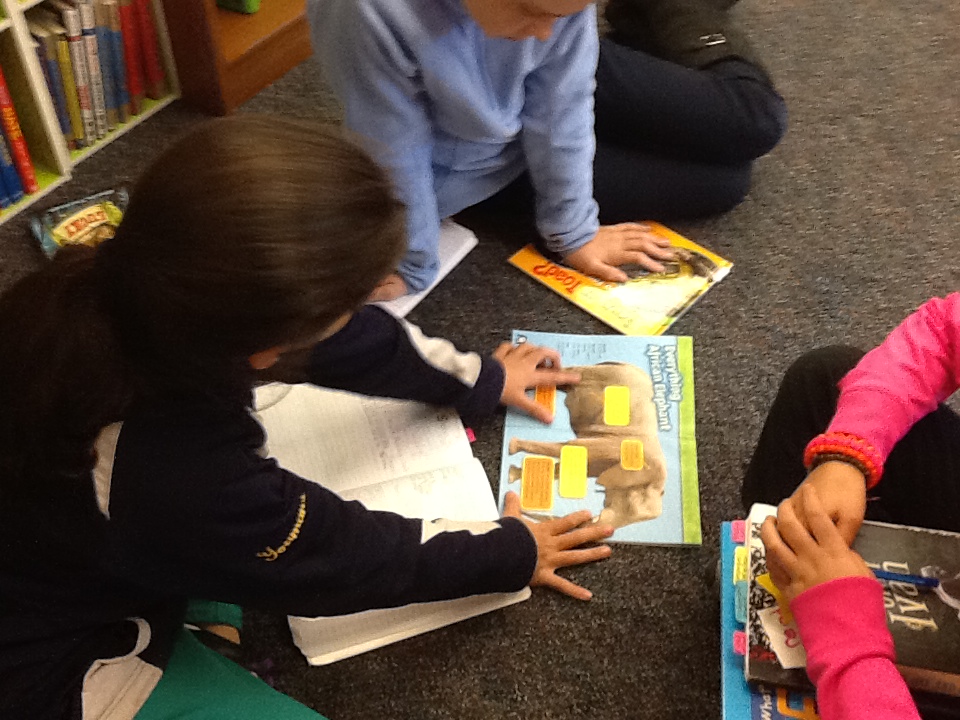
Partner Conversations in Nonfiction Unit: Part 3

This is the 3rd post in a series about our Nonfiction Unit.  To read my previous posts, click below: 
During our nonfiction unit, students still read their fiction chapter books so I have students meet with their partners in the middle of reading workshop, instead of at the end, to clearly split up the nonfiction and fiction reading. For example, after the mini-lesson, students go off to read their nonfiction texts.  After about 15-20 minutes, I pause them for a mid-workshop teaching point that leads them into their partner conversations.  In our classroom, we have Partner 1 and Partner 2 identified in partnerships so each day I alternate between having one of the partners do the teaching, while the other actively listens and asks questions to deepen their understanding and thinking.  After talking for about 5 minutes, I have students end their conversations and switch to their fiction reading.  During this unit, some partnerships have chosen to read nonfiction texts on the same topic or the same text, while some have chosen to read texts on different topics, but read the same fiction chapter book.  

During their partner conversations, they use: 
  • their texts to open up and point to specific information
  • their reader's notebooks to share information and thinking they jotted in their notes 
  • the post-its they used to mark important places in the text. 
I have modeled how to use the text and notes during a conversation to actively involve and teach their partner as well as how to be an active listener and ask questions to deepen your partner's thinking and learning.  We also have numerous fishbowl conversations, where partnerships model a conversation in the middle of a circle and we listen, watch, and notice what they are doing to have a powerful conversation.  This helps students see what a successful conversation looks like and the visual helps them be able to try out those conversational moves and strategies in their own conversations.  

Below are some photos showing the partner conversations in action: 


Happy Reading, Writing, and Talking about Nonfiction! :)


Wednesday, October 24, 2012

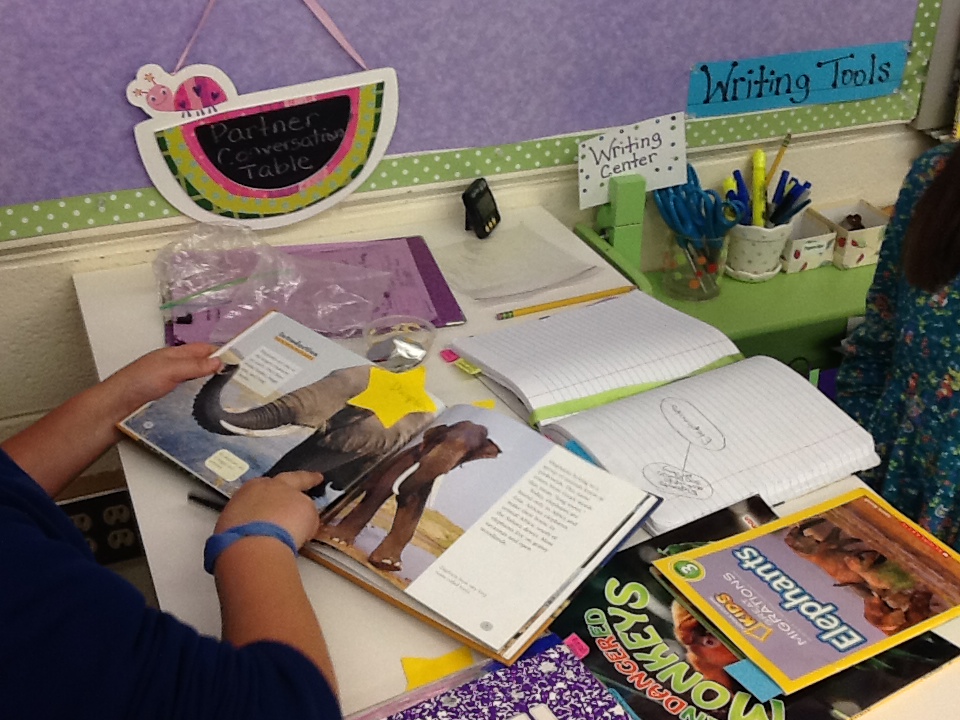
Writing Partner Conversation Table

This summer, I wrote a post about A Quick Guide to Reviving Disengaged Writers by Chris Lehman and shared some ideas that I wanted to implement in my classroom this year.  One of the many ideas I have tried so far is creating a "Partner Conversation Table".  This is a designated spot where writing partners can meet to talk during writing workshop while others are writing.  In chapter 3 of the book, Chris Lehman shares ways to set up this routine and area in your classroom as well as a recording sheet partnerships can fill out if they use the partner spot during writing workshop. 

 In my classroom, writing partners have always met at the end of writing workshop to share and talk with one another, but they sometimes wanted to talk during writing workshop too.  So I had writing partners sit near one another while writing in case they needed advice or had a question for their partner.  However, some writing partnerships took advantage of this privilege and did more chatting than writing.  Some writers who needed a quiet space to write, were distracted by nearby conversations.  So when I read the idea that Chris Lehman shared about having a specific spot in the classroom for writing partners to meet while writing, I loved it

So this summer, I went on a hunt for the "perfect" partner conversation table and stools and found them at Ikea (I love that store by the way for classroom furniture!).  I set up the table, stools, clipboard with recording sheet, a timer, and sign that says "partner conversation table".  So now, in writing workshop, if a partnership wants to confer with one another, they go to this partner spot to have brief five minute conversation.  They set the timer for five minutes and begin their conversation.  Before leaving the "partner conversation table", they complete the recording sheet on the clipboard where they write their name, date, purpose of conversation, and where I can see benefits of the conversation.  This recording sheet holds the students accountable for their conference and also helps me form small groups and/or plan for conferences based on similar needs students have.  This "partner conversation table" has cut down on the chattiness throughout the room during writing workshop when students are independently writing, reinforces the purpose of a partner conference, helps students who need a quiet space to write, and holds partnerships accountable for purposeful talk.  The students love using this table to talk with their writing partners and feel "grown-up" when they ask their partner if they can confer with them at the table.  They also love using the table at other times during the day, other than writing workshop to work with partners.  
Partner Conversation Table 
Recording Sheet at Partner Conversation Table

Happy Writing and Conferring! :)


Sunday, September 23, 2012

Reading Partnerships

During our first unit of study in reading workshop, we are learning strategies active readers use to increase stamina, engagement, and comprehension.   Here is a chart listing some of my mini-lesson teaching points during this unit:  
Part of being an active reader, is having conversations about our reading with others and writing about our reading to prepare for conversations.  To ensure we make time for these important conversations, we dedicate the last 10 minutes of reading workshop to partner conversations on Mondays, Wednesdays, and Fridays.  On Tuesday and Thursdays, we write in our reader's notebook for the last 10 minutes of reading workshop.  This schedule not only ensures that students are given time to do this important work as readers, but also makes sure there is a balance between talking and writing about reading.  

Before students wrote down three possible classmates on an index card they thought would be a good reading partner for them, we talked about the purpose of a reading partner and identified qualities of a good reading partner.  

         
I work hard to always make the purpose clear to students about what I am asking them to do as learners so they understand the "why?" behind everything we do in our classroom.  I also think it is important for students to see the connection between their writing about reading and their partner conversations.  When students gather for a partner conversation, it is expected they will refer to their book and reader's notebook during the conversation and use them as tools to help them have a thoughtful conversation.  
I am a firm believer that students need to be explicitly taught how to have successful partner conversations, need to have conversations modeled for them, and need opportunities to share what they noticed about the conversations they watched.  In my classroom, we refer to these modeled conversations as "fishbowl conversations".  The partnership modeling the conversation sits in the middle of the circle on the rug and the rest of us actively observe by watching and listening in to the conversation by making a large circle around them.   I let students know that I will be asking them, "What did you notice?" when I pause the conversation, so they need to be ready to respond and share their noticings.  This is also a great way for them to learn from one another and also honor their hard work as learners.  

I'd love to hear your thoughts and ideas about reading partnerships and ways you model conversations with your students.  


Friday, March 16, 2012

Thinking Stems

Years ago, I started using thinking stems daily in my teaching and it has raised the level of the teaching and learning in our classroom.  Some of my favorite thinking stems are:
  • This makes me realize..
  • This is important because...
  • This reminds me of...
  • I used to think...but now I think...
  • Sometimes in life...
  • This makes me think...
  • Maybe...
We use these thinking stems across the day in all lessons, conversations, writing, and read aloud.  These stems appear to be simple, but they are powerful (remember, some of the best things come in small packages!).  Rather than me writing these stems on a chart and posting it in our classroom where it could gather dust and never be looked at, I hand the ownership of creating the stems over to the students.  I have a conversation with them about what a "thinking stem" is and give them a couple of examples.  Then I have them turn and talk to brainstorm some other possibilities. We talk about the purpose of the thinking stems and students realize how the thinking stems can deepen and extend their thinking to higher levels.  Once we generate a list of about ten thinking stems, students volunteer to write one of the thinking stems on white oaktag, making it colorful and decorating it with illustrations.  I hang these decorated and personalized thinking stems on our walls where they stay all year and we continue to add to the walls throughout the year as we develop new and revised thinking stems.  Since the students make the thinking stems, they truly use them daily as a reference when they are turning and talking with partners, having whole class conversations, writing about their reading, writing during writing workshop, and during lessons.

 Examples of Decorated Thinking Stems Created by Students
More Examples of Decorated Thinking Stems Created by Students


When students have conversations with their partners, partner 1 will share his/her thinking while partner 2 will give thinking stems as prompts to push his partners thinking to higher levels - the students love doing this because they feel like the teacher!  The students also love to give me thinking stems while I am thinking aloud about a read aloud or modeling my thinking during a minilesson - they try to stump me and love watching my wheels spin to think of how to use the stem to lift the level of my thinking :). 

While writing about their reading or working on a writing piece, students use thinking stems as a visual strategy to deepen their thinking and grow their original ideas.  For example, they write an idea on the top of the page and continue to build upon the idea by using arrows and thinking stems. This shows them how they can begin with one idea and end up with a new and more complex idea.

Happy Reading and Thinking! :)