Showing posts with label Growth Mindset. Show all posts

Friday, October 3, 2014

Discussing Growth Mindset Early in the Year

A few years ago, I read Mindset by Carol Dweck and it completely lifted the level of my thinking as an educator and learner.  I immediately wanted to teach the concept to my students that year and make them aware of their mindsets as learners.  To read all of my posts I wrote about mindset and teaching students about the difference between a growth mindset and fixed mindset, click here.  To read my post that describes the difference between the two mindsets and my first introduction to students about the concept, click here. 

Ever since I read Mindset by Carol Dweck and read additional books about the concept, I always introduce the concept to students during the first week of school through read alouds.  We read picture books with characters who demonstrate perseverance, along with characters who may want to give up at the beginning, but then realize they CAN do it in the end. I always read The Dot on the first day of school to begin these important conversations by talking about Vashti and noticing how she didn't think she could draw at the beginning, had little confidence in herself, and became very frustrated.  Then we discuss how Vashti changed at the end and began to work harder and built up confidence in herself as an artist.  This discussion leads us to the power of the word YET and how when we can't do something, we should say, "I can't do this YET" instead of "I can't do this."  See our class chart below for The Dot by Peter Reynolds.  
                                          
In addition to The Dot, I also read aloud a new book, The Magnificent Thing by Ashley Spires, that I came across this past summer.  This is a perfect picture book to read aloud to discuss perseverance - what it looks like and sounds like.  It also reinforces that making mistakes and failing is part of the learning process and that you should keep trying and put in 100% effort into your goals and dreams.  In this book, the character has an idea that she wants to make something magnificent, but each time she tries it doesn't come out the way she pictures it in her mind.  Even though she continues to fail multiple times, she keeps on trying.  Even though she still gets frustrated and thinks for a second that she should just give up, she doesn't. This is a powerful read aloud to discuss perseverance and growth mindset.  
                                               
Once we read aloud a few picture books that have characters who don't give up, I begin to go back to those charts to discuss growth mindset - what it looks like and sounds like.  The students realize that the characters in those books have a growth mindset and begin to think about other characters in books they have read who also have a growth mindset.  I teach students that having a fixed mindset is the opposite of having a growth mindset. Then I have students work together as table groups to create t-charts to jot down what they think a growth mindset and fixed mindset looks like and sounds like. Below are two examples of charts groups made: 


After groups have time to discuss the differences between the two mindsets and jot down their thinking, we share ideas as a whole class.  Below are two charts we created to compile the students' thinking about the two mindsets. The first chart is our draft that I jotted quickly as students shared out, and the second is the one we have hanging up above our smartboard in the front of the class as a reminder to strive to have a growth mindset as learners.  


During the second week of school, once students have discussed the concept of the mindsets and have an understanding between the two, I have students write a personal reflection about their own mindset.  We talk about how it is possible to have a growth mindset in one area and a fixed mindset in another.  For example, you may have a growth mindset in reading and writing, but a fixed mindset in math.  Or you may have a growth mindset while playing sports, but a fixed mindset when it comes to school. 

Below are two examples of personal reflections that students wrote about their mindsets as learners. Students will continue to write personal reflections about their mindset throughout the school year and at the end of the school year they will compare their reflections to see how their mindset has changed throughout the course of the year.  

 
In addition to conversations and reflections, we also consistently talk about mindset during our read alouds throughout the year.  For example, this week we are finishing our first chapter book read aloud, Fish in a Tree by Lynda Mullaly Hunt, and students have shared their thinking about the characters' mindsets and noticed the word "Grit" that Mr. Daniels used and how it is connected to growth mindset and perseverance.  Below is one of our 5 charts we created during our read aloud for Fish in a Tree that  shows some students' thinking about mindset.  


If you have not read Mindset by Carol Dweck yet, I highly recommend that you add it to the top of your stack to read.  Ever since I read it a few years ago and began teaching and discussing the concept of mindset with my students, I have noticed the positive impact it has on my students as learners and individuals.  

Stay tuned to hear more about how we are discussing mindset and striving to have a growth mindset in our classroom! :)


Sunday, February 2, 2014

Mid-Year Student Reflection on Mindset

Since the beginning of the school year, I have been teaching students about the concept of mindset and the difference between having a growth mindset and fixed mindset.  Click here to read the post I wrote about introducing this important work to students in September.  Throughout the school year, we have been identifying characters, through read aloud and independent reading, who have a growth or fixed mindset and discussing why.  We have also role-played during morning meeting and/or closing circle what having a fixed mindset and growth mindset look like so students have a visual for the differences between the two.  Students use the language of mindset often in our classroom discussions and some students have even written literary essays about characters who have a growth mindset.  So they are transferring the concept of mindset into their daily language, their reading and writing, and while they are working on math challenges as well.

So this past week, I decided to have them reflect on their mindset and how it might have changed from the beginning of the school year.

I posted two questions on a chart titled, "Mindset Reflection" : 

  • Do you consider yourself to be a person with a fixed mindset or a growth mindset? Why? 
  • Has your mindset changed since the beginning of the school year? Why?  

Here are some of the students' answers to these reflective questions: 

"I think I have a growth mindset because I never give up and I also always try my best.  If I make a mistake, I will try to fix it and understand why I made that mistake.  This is why I think I have a growth mindset."

"I think I had a growth mindset at the beginning of the year and I still have one now, but I think now I look at things differently for the better.  I don't know how to explain, but I feel more positive like I am more self-confident.  I feel accomplished and proud of myself even though I have a ton more goals to reach."

"I think I have a growth mindset because I like challenges and I like taking risks.  This tells me that I like to never give up.  I set a goal to always try my best and be responsible and kind.  I always try to put 100% effort into my work at school and at my house." 

"I started having a growth mindset in the beginning of the school year because I started becoming a better reader.  I'm putting 100% effort into my essays now.  I'm being more respectful now then the beginning of the school year.  Now I have more of a positive attitude now then the beginning of the year." 

"I consider myself to have a growth mindset.  I think this because I don't give up on things or people.  I don't give up on things because my family doesn't give up and I want to carry that on.  I don't give up on people because people will bring you down, but I was taught to always have the strength to pick yourself up and tell myself, I don't deserve to be treated that way!"

Reading through all of the students' reflections, gave me clearer insights into how they perceive themselves as learners and how I can also help them continue to work toward having a growth mindset.  It also raised an important question in my mind: Are mindset and kindness connected?

As you can see from a few examples shared above, some students connected the concept of having a growth mindset to being kind and respectful.  This year, one of our school-wide objectives is to teach students how to be kind and use respectful language with one another.  I have not talked about how being kind is related to mindset, but obviously students are seeing the connection on their own and are bridging the two together in their minds.  I have thought long and hard about this over the weekend and I do see how they are connected and want to have this conversation with my whole class to create a chart on how they see mindset and kindness connected.

From reading their reflections, it seems that they believe if you have a growth mindset and know that everyone CAN do something with practice, then they won't be tempted to tease someone for not being able to do something well YET and will be kind.  Also if someone has a growth mindset and likes to take risks as a learner, they are more apt to cheer their classmates on and try to boost their confidence in themselves which is being kind.  They are also more likely to stand up for classmates who may be receiving negative comments from classmates.  This is just what I have brainstormed myself after reading how some students connected mindset to kindness in their reflections.  I am eager to have this conversation with my whole class on Monday so stay tuned to hear more!

Enjoy the weekend!


Saturday, January 4, 2014

Revisiting Class Expectations for the New Year

Last week, I was inspired by Pernille Ripp's blog post titled, "Back to School - January Edition." 
In this post, Pernille lists multiple ideas teachers can try out in their classrooms after getting back to school from the winter break.  I loved the first idea to reassess classroom rules.  I always had the intention in September to revisit the class expectations that we create, but each year the time slips away and I never end up doing it. After reading her post, I decided to write it into my plans for the first day back to school after the New Year and I am so glad that I did! It was a powerful lesson and the students showed me how much they have grown as part of our classroom community and as learners.

I began the discussion, by taking down the chart created in September that listed the two expectations students thought were most important for our classroom community: Be Kind; Be Responsible.  I reminded them that these were chosen in September and now that we have been together for about 4 months and know each other as individuals, we may want to revise them.  I first gave them thinking time to reflect on the two expectations and if they felt they needed to be reworded, replaced, or added to.  After giving them a few minutes to think independently, I had them discuss with their table groups to share their thinking.  Then each table shared their thinking and I wrote their opinions on a chart for all to see during this decision making process.  Once we had some ideas listed, I repeated the process with thinking time and group discussion.  The class decided that we should have a class motto: Always try your best! Then listed below the motto, they wanted a list of examples of what we should always try our best to do in class and out of class.

So far, this is what they came up with:

Always try your best!

  • Be responsible.
  • Be kind
  • Put in 100% effort into all work
  • Have a growth mindset
This is a work in progress and it was disrupted by a snow day the following day so we will return to this reflective process on Monday.  I was so excited to see that the concept of growth mindset was brought up by the students and they felt it was important enough to add to our expectations chart! I also love that they value the power of effort and the importance to always try your personal best! This process was not only beneficial for the students but was powerful for me to watch and see how they have grown as learners and individuals so far this year.  

If you have revisited your classroom expectations or decide to try this out, please share!
Stay tuned to hear how we also set new goals for the New Year in our classroom. :)

Happy New Year! 

Monday, December 16, 2013

It's Monday! What are You Reading?

Jen Vincent and Kellee Moye cohost It's Monday! What Are You Reading weekly on their blogs.   To see what others are reading and recommending each Monday, or to participate, be sure to check out their blogs Teach Mentor Texts and Unleashing Readers


One of my students recommended Maggie and Oliver or a Bone of One's Own by Valerie Hobbs to me and I am so glad she did! Maggie is an 11 year old orphan who finds herself on the street having to find a way to survive on her own.  Oliver becomes a homeless dog when his owner passes away so he must also find a way to survive out on the streets just like Maggie.  The book tells both Maggie and Oliver's story and connects the two stories at the end.  I read this book in one sitting and loved how it reminded me of Annie too! I highly recommend this book! 


I have been doing a lot of reading and work around the concept of growth mindset vs. fixed mindset for the past couple of years so I was excited to see the new book, Mindsets in the Classroom: Building a Culture of Success and Student Achievement in Schools by Mary Cay Ricci. I started reading this book last week and had time on the train this weekend on my way to NYC to finish it - I loved it! I highly recommend educators to read this professional book and share it with their colleagues.  It would also be a great choice for a faculty book club to read and discuss at faculty meetings.  There are many beneficial strategies, charts, descriptions, quotes, etc. that help educators build a growth mindset culture in their classrooms and schools.


I am very fortunate and grateful that my principal shares professional books and articles from ASCD with me - thank you Grace! The latest book that she let me borrow was The 12 Touchstones of Good Teaching by Bryan Goodwin and Elizabeth Ross Hubbell. This professional book discusses the CCSS, how to use checklists with students and teachers in beneficial ways, how to give feedback that fosters a growth mindset, and how to align the standards to our teaching while challenging students to expect more of themselves in the process.

Some of my favorite lines that I marked with post-its are:

  • "As you develop lessons, you should use standards both as a rearview mirror to look back on the knowledge and skills students should have acquired prior to reaching your classroom and as a windshield to help you anticipate the knowledge and skills teachers in later grades are counting on you to teach your students." (page 12)
  • "Teachers should use standards to structure student learning and the curriculum while using their own creativity to develop lessons and unit plans that are lively, intriguing, and motivating to students. " (page 13)
  • "Teachers can inadvertently diminish student motivation and achievement by praising for ability instead of effort.  That's why it is important to guard against praising for ability and ensure that all comments to students reinforce the importance of their effort and its link to their achievement." (page 96)

Enjoy reading this week! :)


Saturday, October 19, 2013

What Impacts our Characters? What Impacts People?

Each year, in fifth grade, we teach a character unit in reading workshop and I love it because it really teaches students how to grow ideas about their characters.  In the past, I usually only taught two mini-lessons on character impact and how events and secondary characters impact the main character.  

This year, I chose to teach four different mini-lessons and focused on: How Events Impact Characters; How Decisions Impact Characters; How Words Impact Characters; and How Relationships Impact Characters (see charts below that were created in each mini-lesson).  This instructional decision had a positive impact on my students as readers and lifted the level of their thinking and understanding for how many different factors impact our characters and cause them to act or feel a certain way.  

After teaching these mini-lessons on character impact, I pushed my students' thinking even further and had them think about how we can apply these same lessons to our lives.  Since we have been talking a lot about fixed mindset, growth mindset, and respectful language in our classroom this year, the students immediately made the connection to how events, words, decisions, and people impact us in positive or negative ways.  This led to a powerful conversation about the power of words and actions and how someone else's words and actions can impact us.  The time spent teaching this string of mini-lessons on character impact was powerful and lifted the level of thinking in my students as readers, learners, and individuals! 


Enjoy the weekend! :)

Thursday, October 10, 2013

Teaching about Growth Mindset Early in the Year

I have written quite a few posts about the concept of having a Growth Mindset vs. Fixed Mindset and being inspired by Carol Dweck's book, Mindset and Peter Johnston's book, Opening Minds.  Click here to read posts I have written about the concept and my learning/new thinking from reading their books.  

This year, I decided to start the year off with talking about the concept of having a growth mindset with my students and not waiting.  Just like last year, I read The Dot by Peter Reynolds on the second day of school and began talking about the power of the word YET and how we should use that word as learners when describing something we can't do YET instead of just saying, "I can't do this, it is too hard." This book opens the doors to a powerful conversation about what having a growth mindset means.  See our class chart below that we created while reading aloud The Dot and what students had to contribute about the word YET and having perseverance instead of giving up on trying.  


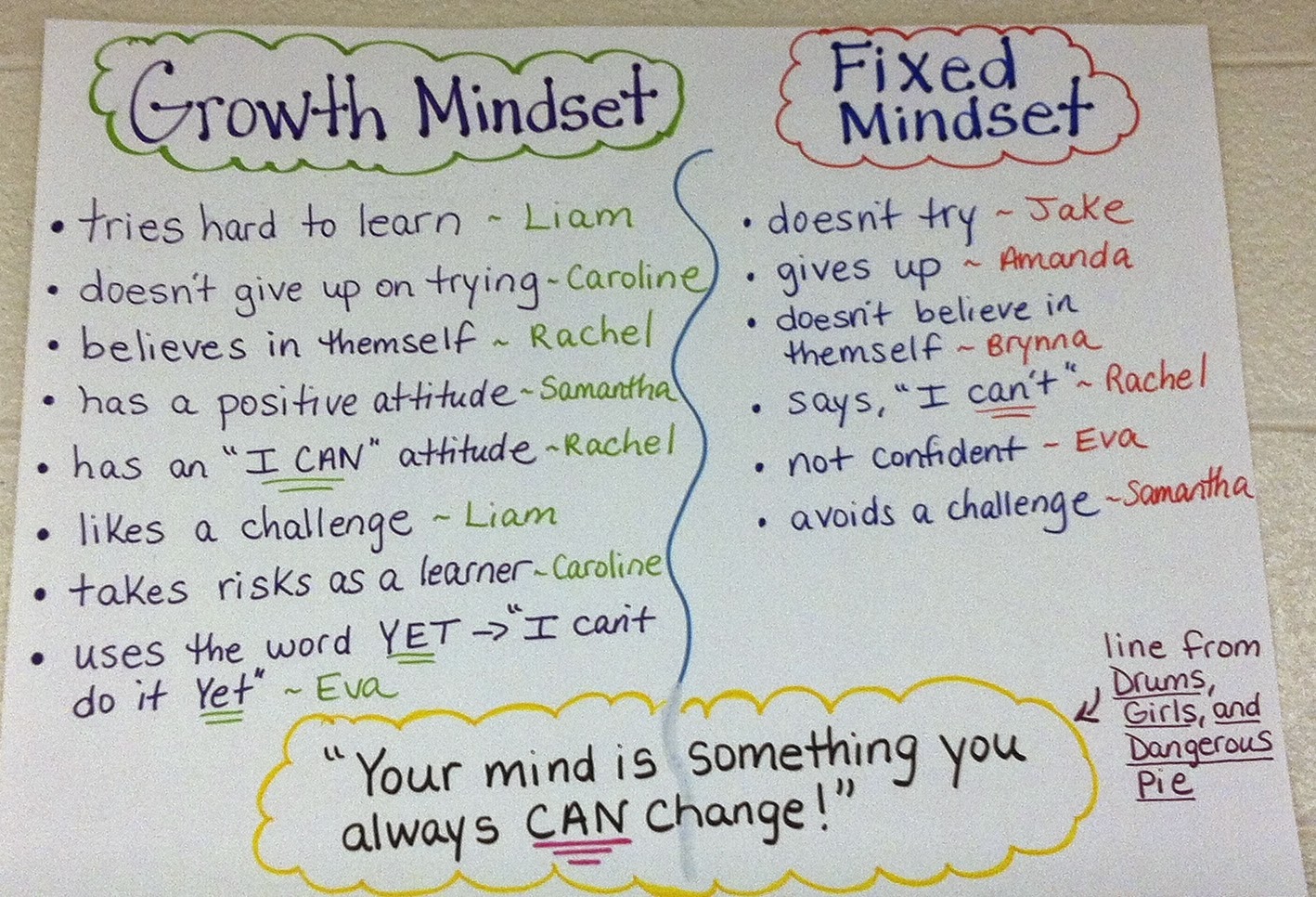
After a few days of talking about the difference between having a growth mindset vs. a fixed mindset, we created this class t-chart to visually compare the two mindsets and how they are opposites.  Students contributed their thinking about the two mindsets and also what a person with that kind of mindset might say.  

While reading Drums, Girls, and Dangerous Pie by Jordan Sonnenblick as our first chapter book read aloud in September, we came across this important line: "Your mind is something you always can change." This line immediately reminded the students of growth mindset so they wanted to add it to our Growth Mindset vs. Fixed Mindset chart so we created a new one below that includes the important line.


I am noticing that students are referring to growth mindset and fixed mindset during partner conversations about their characters as well as during turn and talks during our read alouds.  They are internalizing these important concepts early in the year as learners and I am seeing students persevere while trying to have a growth mindset themselves.  I will continue to have conversations with students about this concept and have students reflect throughout the year about their own mindsets as well as the mindsets of characters.  

If you have not read Mindset by Carol Dweck or Opening Minds by Peter Johnston, I highly recommend that you add them to the top of your stack to read.  I read these books for the first time a over a year ago and they have impacted my teaching and learning in multiple ways! 


Saturday, March 2, 2013

The Power and Meaning of Our Words

Last year I read Opening Minds and Choice Words by Peter Johnston and participated in the #CyberPD online discussion about Opening Minds - click here to read my posts.  After reading the book and discussing it with others online, I told myself that I was going to eliminate comments such as, "Great!"; "Good job!"; "Excellent!"because they are types of praise that are not specific and do not promote learning.  I know most of us can probably admit to using these comments in our classrooms at some point.  I am probably still guilty of using them, even when I vowed not to after reading Opening Minds.  I try to always be aware of my word choice and catch myself, but I may still use them without even noticing.
 For the past few weeks, I personally experienced what it feels like to be on the receiving end of these comments because my pilates instructor uses them in her classes.  Each week, I go to pilates reformer classes at a nearby studio and as my pilates instructor walks around during class, she frequently says, "Perfect"; "You got it"; "Great job"; "Good job".  I didn't think anything of it until I received a "Good job" one day as she was near my reformer and then immediately said, "Perfect" to the woman across from me.  I could not help thinking, "What is she doing better than me to make it 'Perfect', while I am just doing 'good'?" Another time, she said, "Perfect" to me as she was near my reformer and now I kept thinking, "I wish she told me what I was doing to make it 'perfect' this time so I can make sure to do it like that all the time!" Receiving these comments made me think hard about how these comments must make our students feel and think.  This week, I paid even closer attention to my choice of words when giving feedback to students and did catch myself a few times - it is hard sometimes not to use these comments, but it is critical that we try to be more specific in our feedback.

We have to always be aware of the power our words have in the classroom and the meaning that is conveyed to our students.  For example, in Opening Minds, Peter Johnston wrote, "Saying 'I'm proud of you' to someone has the same effect as saying 'I'm disappointed in you.'" This made me realize that when we say, "I like the way..."  we are giving other students the impression that we don't like what they are doing and the feedback is in the form of a judgement.  Also if we say, "Good job" to one student but then say, "Excellent job" to another student, how does that make the first student feel?  I admit I am still faulty sometimes of using person-oriented praise and am going to continue to work extra hard to give productive feedback that is process-orientated in my classroom.

I am thinking of having an open conversation with my class this coming week about feedback/praise and ask them to reflect on what they feel and think about when they receive general comments like, "good job."  I am also thinking of asking them to help me continue to become stronger in giving specific, process-oriented feedback by asking me, "What makes it good vs. great or perfect?" if I ever give them a comment like that.  I want them to advocate for themselves and call me out on it because I want my feedback to help them grow as learners, instead of making them feel like they are doing something wrong because they received a "good job" when someone else was told they are doing, "great, excellent, or perfect."  

I'd love to hear your thoughts and about any strategies you use that help you give specific feedback to students that is process-orientated instead of the general praise.  


Monday, September 24, 2012

It's Monday! What are you Reading?


Thank you Jen and Kellee for hosting this weekly!  To see what others are reading and recommending, or to participate, be sure to check out their blog Teach Mentor Texts :)

This week, instead of sharing books I have read this week, I am going to share a book we have had great conversations about this week in class.  
I read aloud The Dot by Peter Reynolds the first week of school and we have been referring to it a lot because it sparked a great conversation about the power of "yet" in our classroom.  This book launched our discussion about Growth Mindset vs. Fixed Mindset and that instead of saying, "I'm not good at..." we should say, "I'm not good at...yet."  The "YET" shows we are working hard at the skill and have a growth mindset.  To read more about the mindset concept and sharing it with students, click here.  Students have been working hard to include the word "YET" in their statements and have been referring to characters in our read alouds as having a growth or fixed mindset - it's great to hear them practicing and understanding the concept! 


Happy Reading! :)

Monday, July 16, 2012

Opening Minds #CyberPD Part 1

Thank you Cathy Mere, Jill Fisch, and Laura Komos for organizing this #CyberPD event schedule for Opening Minds by Peter Johnston.  Please visit their blogs to read many powerful posts about Opening Minds and to find out more about this #cyberPD that is currently in process on blogs and Twitter using the #cyberPD hashtag.

I have read and reread Choice Words by Peter Johnston and always come away with new learning and  a-ha moments. It is a short book, but jam-packed with ideas that impact the language we use in our classrooms to build positive learning communities.  Since reading Choice Words helped me see how powerful words can be and that our language is a powerful teaching tool, I was thrilled when Peter Johnston's new book Opening Minds was published.  I was so excited to read it, that I immediately downloaded the e-Book version to avoid having to wait for the shipping.  I have read the book twice so far and know that I will be rereading parts over and over again until I internalize the language.
My take-aways, thoughts, and reflections from the first three chapters of Opening Minds by Peter Johnston are: 

Fixed Mindset vs. Growth Mindset: 
I read and loved reading Mindset by Carol Dweck and shared the concept of fixed mindset vs. growth mindset with my students this year.  It was so powerful to share the concept with students (click here to read more about how I shared it with students).  I love how Peter Johnston discusses the important concept of mindset in Opening Minds and how it relates to the language we use in our classrooms with students.  For example, when we say,"I'm not good at.." or "You are good at.." or "You are so smart at..." we are modeling fixed mindset attributes.  Johnston explains in chapter one that saying someone is smart is just like saying someone is dumb and we would never use the word "dumb" when speaking to students.  Changing our statements from "You must be smart" to "You must have worked hard" models a learning frame of mind rather than a fixed frame of mind.   Instead of saying, "I'm not good at..." we need to use the word "yet" to emphasize the fact that we need to work hard and practice the skill to continue to grow as a learner.

"I'm not good at this yet."  
This word is small in size but powerful in meaning.  Using the word, "yet", is the difference between seeing intelligence as a fixed character trait and as something that grows with learning.  By saying "yet", we are acknowledging the fact that we are in the learning process and are still working on strengthening this skill/strategy.  I need to practice using this in the classroom when referring to myself because I have a habit of saying "I'm not good at drawing" when in fact I never practiced it in my life or even tried to because it never interested me.  So instead of asking students to draw something because "I'm not good at drawing", I can say, "I'm not good at drawing this yet because I still need to practice." Our goal is for students to say, "I'm not good at this yet" and to take the necessary steps to change that.  Yet is a key word and needs to be modeled and emphasized in our classrooms so it becomes internalized by our students and us.

"Our language choices have serious consequences for children's learning and for who they become as individuals and as a community (pg.7)."
Our language needs to show students that we believe things are changeable because if they can't be changed then working hard and practicing is pointless.  We need to model and show students that working hard and trying helps us grow and change as learners in all areas.  Learning is a process, not a fixed trait of being smart or dumb.  To help increase students awareness of the learning process, we can ask, "How did you do that?" How did you figure that out?" These questions get students to think about their thought process and therefore the learning process.  As teachers, we also need to model that making mistakes is part of the learning process and that it is okay to make mistakes because we learn from them.   I love the line on page 3 when the teacher says, "I make mistakes just like you."  She made it clear to her students that when you make a mistake, you fix it and learn from it.  This is an important message to make clear in our classrooms to help create a safe learning environment where students feel safe to make mistakes, go out of their learning comfort zone, and take risks as learners to continue to grow.

I will be posting again for #cyberPD later this week about the next three chapters so stay tuned.  Please visit the blogs linked at the beginning of this post to read more thoughts about this powerful book and to get linked to other blogs participating in #cyberPD.  Thank you again to all of the organizers of #cyberPD :)

Happy Reading! :)


Saturday, June 23, 2012

End of Year Reflection - Top 5 Takeaways from Students

At the end of each year, I pause to reflect on my big take-aways as a teacher and learner as well as have my students reflect on their year.  In past years, I sometimes used thinking stems to prompt their reflections or asked them specific questions to reflect upon.  This year, I asked my students to write down their "Top Five Take-aways" from the year.  When I attend conferences and workshops, I tend to walk away thinking about my "Big Take-aways" so I decided to have my students try out using the same reflection strategy. Throughout the year, I continuously ask my students to reflect on their learning so they were not surprised when I asked them to participate in an end-of-year reflection.  Reflection is a critical and necessary component of the learning process and I firmly believe that without reflection, we would not have learning.

Some highlights from their "Top Five Take-aways" were:
  • Creativity and Problem Solving - "This year, I have learned how to solve problems in new and creative ways.  I have realized that there is always an answer, and I need to push myself to find the best solution."
  • Teamwork - "This year, I have learned to works as a team and I realize that teamwork involves taking turns and collaborating."
  • Having a Growth Mindset instead of a Fixed Mindset - "I've learned to always have a growth mindset and go the extra distance to reach my goals." "I learned to be more confident and always be up for a challenge."
  • Perseverance - "I learned to never give up and try my hardest."
  • Conversation Skills - "I learned how to have a successful book club conversation and how to get my ideas across."
  • Charts - "Before this year, I can't remember using or creating charts a lot.  I have learned how to make charts work for me.  Now they help me as a reader and writer."
  • New Book Titles and Recommendations: "Here, in this classroom, I have had the chance to read so many books! I love to read and it was great to have so many choices!"
About half of the students in my class wrote about the Growth Mindset concept and how understanding the concept is helping them.  I loved seeing this because it shows that they truly internalized the concept that I taught them earlier in the year about Mindset.  As educators, it is so important for us to strive to have a Growth Mindset and to understand the difference between mindsets, but I believe it is equally important for students to be aware of and understand the concept.  

I was also excited to see that the students internalized and are taking away essential skills they will use as lifelong learners from this year in 5th grade. :)

I'd love to hear about other ways you had your students reflect on their year of learning in your classroom.


Friday, April 13, 2012

Sharing the Concept of Mindset with Students

Two weeks ago, I wrote a post about attending a Common Core Conference and hearing about the book, Mindset by Carol Dweck. In that post,  I reviewed how Mindset impacted me as a person and as an educator.  After reading the book, I became intrigued by the Mindset concept and began reading articles online about it, tweeting about it, and joining the #educoach chat recently about it. I decided to share the concept of a Growth Mindset and Fixed Mindset with my students.  I discovered this chart in a post about Mindset on the Thoughtful Learning Blog to use as a helpful visual while sharing the two different mindsets.  
  
Yesterday during morning meeting, I had the chart up on the Smartboard while I gave real life examples of students who have a fixed mindset and students with a growth mindset.  Then I asked the students to think about which mindset they have as learners and put a thumb up when they could explain their reflective thinking. Students turned and talked to share their reflections with their partner.  Many of my students shared that they considered themselves to be in the middle and found that they have some growth mindset traits while also having some fixed mindset traits.  I was extremely impressed by how mature, honest, and high level their conversations were as they reflected upon themselves as learners.  Some were brutally honest and admitted that they completely have a fixed mindset and gave specific examples to support their reflection.  I asked students to think of a plan to help them work towards turning one or more of their fixed mindset traits into a growth mindset trait.  They turned and talked with their partner to help one another with their plans and goals. 

After their conversations, I had students go off to write about their current mindset and describe their goal and plan of action to achieve their goal.  Here are some examples of their written reflections that I collected:
I will continue to use the words “Growth Mindset” and “Fixed Mindset” in our daily conversations, lessons, and reflections.  I will also hand back their mindset reflections in about a month so they can continue to reflect on the growth they made working towards their mindset goals. 

I’d love to hear your thoughts about sharing the Mindset concept with students/colleagues and how you are helping students/colleagues work towards having a growth mindset rather than a fixed mindset as a learner and as an individual.   
Happy Learning! :)

Monday, April 2, 2012

It's Monday! What Are You Reading? Mindset by Carol Dweck


On Friday I went to a Common Core Conference and the speaker, Dr. Cathy Lassiter, repeatedly referred to the professional book, Mindset by Carol Dweck .  She emphasized that we need to address the mindsets of teachers and students if we are going to have rigor in the curriculum.  Carol Dweck believes in two mindsets: fixed and growth.  Teachers with a growth mindset look at students as clay, believing that they are malleable and will learn anything you teach them.  Teachers with a fixed mindset aren’t as persistent in their teaching and think that certain students either are equipped with what they need to learn or don’t have what it takes.  Students with a fixed mindset are more likely to give up because they think they can’t do it, while students with a growth mindset will persevere and keep trying while enjoying the challenge. 

I listened to this explanation of mindsets, and I was thankful to my grandfather for instilling the growth mindset into me at an early age.  I can still hear his words, “You can do anything you put your mind to” and “Your knowledge is yours to keep forever; no one can ever take it away.” I always welcome challenges, take risks as a learner, and expand my comfort zone to extend my learning to higher levels.  Thank you Papa Joe for helping me become a lifelong learner like you! In addition to being thankful to my grandfather, I immediately had pictures in my mind of students who repeatedly say, “I can’t do this” or “I will never be able to…” and knew I had to read this book to learn more about the fixed mindset that these students have.  I immediately texted Melanie Meehan and asked if I could borrow the book to read this weekend.  

Some of the highlights from Mindset by Carol Dweck are:

People with a Growth Mindset:
·        thrive on a challenge
·        persevere
·        thrive when they are stretching themselves
·        say, “I don’t know how to do that yet”, and
·        are determined.

People with a Fixed Mindset:
·        lose interest when things get too challenging
·        stay interested only when they do well right away, and
·        say, “I can’t do that”.

I am going to share these highlights with my students this week and make them more aware of what kind of mindset they currently have, and how they can make changes if they have a fixed mindset.  I agree with Dr. Lassiter that we can’t have rigor in our curriculum until we address the mindset issues, but I also believe that these are lifelong skills that we need to teach students so they can expand their dreams. 


Happy Reading! :)