Showing posts with label bulletin boards. Show all posts

Monday, May 20, 2013

Historical Fiction Book Club Unit: Part 3


This month, students have been working hard in their historical fiction book clubs to read, think, write, and talk deeply about their historical fiction books.  They have been creating charts and using a variety of note-taking strategies to help them prepare for their book club conversations that they have on Mondays, Wednesdays, and Fridays.  Students choose whether to write their thinking on post-its, in their reader's notebook or book club notebook, or use Google Drive to help them deepen their thinking and prepare for their conversations.  

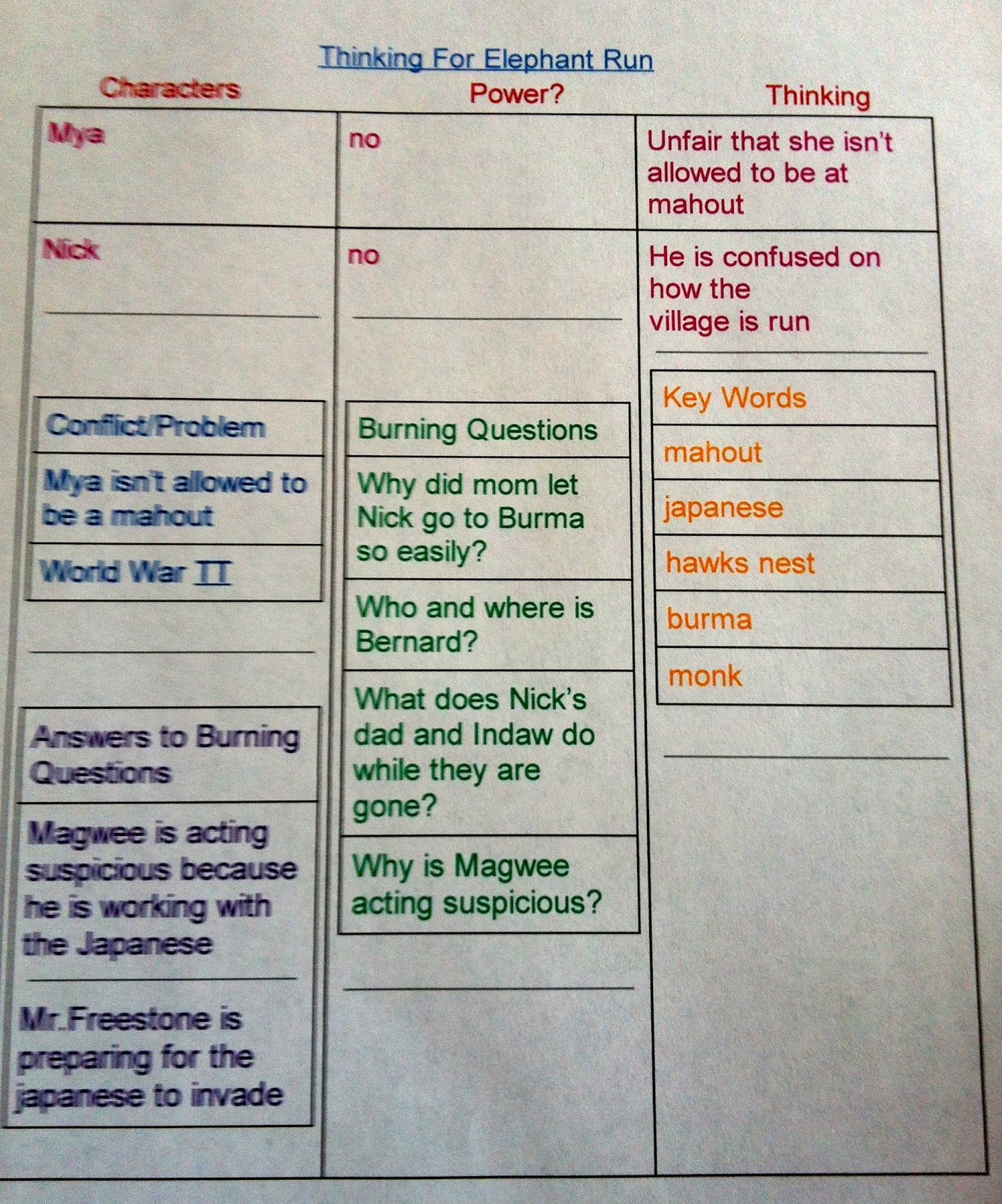
Below are some examples of the work students have been doing in their notebooks and on Google Drive to prepare for their conversations:

Bulletin Board where students post examples from their notebook 
Example of how one student used Google Drive to create a chart 
Another example of how one student used Google Drive to create a chart
Example of a chart created on Google Drive 
Example of a chart created on Google Drive


Example of a plan one student created in preparation for conversation
   

Have a great week! :)


Friday, May 10, 2013

Historical Fiction Book Club Unit: Part 2


Students have been working hard these past two weeks to internalize and apply the skills/strategies I am teaching in mini-lessons into their book club books and conversations.  Since read aloud is an extremely important part of our day as a class, a lot of my modeling for writing and talking about reading occurs through read aloud.  Students have been watching me make different charts for each read aloud since the first day of school (and we have read A LOT of books) so they are "chart experts" themselves at this point and we are all learning strategies from one anther on ways we can keep track of and extend our thinking. 

At the beginning of our historical fiction unit, I read aloud about eight different picture books to expose students to various historical conflicts and time periods to help build their background knowledge about time periods they may be reading about in book clubs.  As we read and discussed these historical fiction picture books, students created their own charts in their reader's notebooks as they do during each read aloud, but they also had some time to create mini-charts as a small group/partnership to showcase their most important thinking about one of the read alouds.  This past week, in my morning message, I gave students the option of working on a mini-chart for a read aloud with a small group/partner until it was time for morning meeting.  Most students opted to create at least one and loved doing it! These mini-charts gave students an opportunity to collaborate with one another, determine what information/thinking was most important since they had limited space on the paper, and allowed them to express their thinking through sketches as well as words.  

Below are photos of mini-charts that small groups/partners created for some of our historical fiction picture book read alouds:  

Bulletin Board with Mini-Charts 

Example of Mini-Chart for The Other Side 

Example of Mini-Chart for Faithful Elephants 

Example of Mini-Chart for The Butterfly 

Example of Mini-Charts for Henry's Freedom Box

Example of Mini-Chart for Freedom on the Menu

Below are photos of some charts students created in their reader's notebooks during our read alouds last week: 


Enjoy the weekend! :)


Thursday, January 24, 2013

Close Reading and Literary Essay Unit

Currently, we are in our Close Reading unit in reading workshop and Literary Essay unit in writing workshop.  The two units are integrated and students are writing about the texts they are reading closely. This is one of my favorite units because it teaches students strategies for close reading which deepen their comprehension, lift the level of their interpretation of texts, and strengthen their conversations and writing about reading.  Each time we begin a new unit, we always discuss its purpose and how it is going to help us as readers and/or writers.  Below is a chart we created during our first mini-lesson when discussing the purpose of the unit.   
For each unit, we also keep track of all of our teaching points for each mini-lesson so we can continue to refer to them, use the chart as a resource during independent reading/writing, and build upon our learning.  It is a great visual for students to see all the skills and strategies they have learned and are practicing as readers and writers.  Below is our first chart we have created with our teaching points - we are on our 2nd chart now of teaching points.  
As students are reading short texts closely, they have been leaving tracks of thinking in the margins and writing patches of thinking in their writer's notebooks. These tracks and patches focus on interpreting the text by analyzing the author's message, symbolism, important lines, character change, theme, theories, and so on.  A few students created this visual below for their classmates to use as a resource as they are working independently to remind them of the different ways they can interpret the text and lift the level of their thinking.  
I always love having students share and display their work so they can learn from one another.  Below are two bulletin boards our class created to showcase our patches of thinking for the short texts we have read aloud and discussed in class as well as their independent short texts they have read during independent reading.  


At the beginning of this week, students read through their patches of thinking and chose a short text to write a literary essay for that would extend their thinking and interpretation of the text.  I wrote my own literary essays to use as models during mini-lessons and mentors throughout the writing process.  We also have been writing a class literary essay together, which has been the basis of our demonstration and active engagement in our mini-lessons.  Students have been busy at work drafting their first literary essay using Google Drive (click here to read about how we are using Google Drive) and are just finishing them  - stay tuned to hear more about our literary essays this weekend! :)


Friday, November 16, 2012

A Peek at the Nonfiction Work in our Classroom: Part 1

This month, we began our nonfiction unit in reading workshop and have been learning new skills and strategies as nonfiction readers.  This is the first post in a series of posts I will be writing about nonfiction.  Below are two of my charts that identify the teaching points of my minilessons so far in this unit.  Each day, I add the teaching point onto the chart and give examples from my demonstration and the students' examples from their turn and talks/stop and jots.  I then hang up the charts above our meeting area so we can consistently refer to what we have learned and how we are building onto our learning.  I do this type of charting for each unit of study.  


Last week, we worked on first determining a main idea of a text  and supporting it with specific details from the text and then moved into determining multiple main ideas for one text.  The students have enjoyed delving deeper into nonfiction texts by asking, What is another big idea this text is teaching me? What's another possiblility for what this text might be saying? 


This week, we have been working on choosing a form of note-taking that best matches the text structure and will best organize the information we are learning.  For example, when reading a text that is comparing two topics, we can use a t-chart or venn diagram; when reading a text that is describing one topic, we can use boxes and bullets or a web; when reading a text with sequence structure, we can create a timeline; and so on.

I have also created pages in my sketchbook that I use for mini lessons, conferring, and small groups, that support this important note-taking work we are doing as nonfiction readers.  Below are some examples from my sketchbook.
                             
In our classroom, we have created a bulletin board that is dedicated to highlighting student examples of note-taking while reading nonfiction texts.  Our bulletin board is divided into sections based on various text structures and note-taking forms.  Students post their examples for their classmates to use as mentors as they explore and try out using different forms of note-taking.

Happy Nonfiction Reading and Note-Taking! :)


Tuesday, October 2, 2012

Using Mini-charts on Bulletin Boards and in Notebooks

This year, I am using mini-charts in addition to my regular size charts and I'm loving it!  I always have charts around the classroom that we create for our current units and we refer to them consistently during lessons, conferences, and while working independently.  I always change up my charts to make sure they are current, have a purpose, and to make sure I'm not wallpapering our classroom with charts.  I don't want it to be overwhelming for students or have unnecessary charts hanging up.  However, sometimes there are still charts that students use or charts that I want students to be able to refer to while at home or when they are in another part of the school working. Hence the idea of mini-charts!

I constantly take photos of our charts, bulletin boards, and student work so when I want a mini-chart, I just print out the photo.  On our back bulletin boards for reading and writing, I hang up the mini-charts  under a section "Our Charts and Strategies" for the current unit.  This way, students can refer to them whenever they want and can easily see a variety of charts at one glance in one spot.  I also sometimes print out photos to give individual students mini-charts to add to their reader's or writer's notebook or math binder if it is a math chart.  Then students have access to our charts wherever they are and whenever they need them.  I also love that the mini-charts don't take up so much space on the bulletin boards as the full size chart paper so it makes more room for student work.  I still have full size charts hanging up in front of the room by our mini-lesson meeting area and hanging on my clothesline that crosses my classroom, but the mini-charts on the back bulletin board are an extra bonus! 


Happy Charting! :)


Tuesday, May 29, 2012

Strengthening the Level of Book Club Conversations

In 5th grade, our students participate in book clubs in at least two of our reading units: Social Issues and Historical Fiction.  This year, I tried something a little different to heighten the level of my students' book club conversations and will definitely do it again next year. 

This year, in addition to using consistent whole class conversations and partner conversations throughout the school year to strengthen their ability to talk about books, I also formed book clubs for some of our read alouds.  For example, in between our Social Issues and Historical Fiction units, I had the book club groups practice how to prepare and have successful conversations around our read aloud, The Running Dream by Wendelin Van Draanen.  

During this week, Melanie Meehan and I acted as a mini-book club to model how to prepare for our conversations and use our writing to have successful conversations during our reading workshop minilessons.  We modeled how to plan for our conversations about The Running Dream, using the chart paper as our reader's notebooks during Tuesday and Thursday's minilessons.  After our modeling, students had time to plan for their own book club conversation for the following day during the active engagment part of these minilessons.  Then on Wednesday and Friday of that week, Melanie Meehan and I modeled how to use our writing that we did on the previous day to have a successful conversation about The Running Dream by having a fishbowl conversation during the minilesson.  After observing our conversation and sharing what they noticed, students went off to have their own book club conversations around the read aloud by using their writing to help them.

Student Example of Preparing for Conversation
(This student even referenced Growth Mindset!!)
By using a read aloud for book club conversations this week, we were able to clearly model and coach into how to strengthen our conversation skills. This indepth work of strengthening students' ability to write and talk deeply about books made a big impact on the level of their conversations and writing about their reading. 

The following week, we launched our Historical Fiction book club unit, but instead of having students begin choosing their historical fiction book club books right away, I had the book clubs focus their conversations  on our picture book read alouds for one week.  On Monday, Wednesday, and Friday of that week, they focused their conversation on different historical fiction picture books that we read aloud such as: Henry's Freedom Box, Freedom Summerand Freedom on the Menu.  During this week, I also had the book clubs create "mini-charts for the historical fiction picture book read aloud that they discussed just like I create charts for each of our read alouds.  I was so impressed by their thoughtful work and the level of their thinking on these mini-charts and in their book club conversations about these read alouds.


After this successful week of talking about the picture book read alouds, each book club chose their own set of 3-4 historical fiction books they will read and discuss during this book club unit.  Their conversations and writing are definitely at a higher level than they were before and as one student said it last week when their work was complimented by another teacher, "That's how we roll in here." :)

Enjoy! :)

Saturday, April 21, 2012

Giving Students Opportunities to Share their Thinking and Strategies

A few weeks ago, I wrote a post on  Involving Students in Creating Bulletin Boards . I want to update you on some new ways my students are sharing their thinking with their classmates and how they are learning from one another.  About a month ago, we started our social issues book club unit and the students wanted to create their own book club bulletin board.  Each book club boxed off a square on the bulletin board using yarn and are posting their thinking, parts of their conversations, and strategies they are using while participating in their book club. 
Our Book Club Bulletin Board
In my morning message to students, I invite them to read their classmates thinking on the book club bulletin board and be ready to honor a book club's thinking/strategy at morning meeting. I also give students time each week to reflect on what they are currently doing well in their book club and which strategy they saw on the bulletin board that they will try out.  These opportunities teach students how to be reflective but also teach them that they can all learn from one another.  In my eyes, we have 26 teachers in the classroom, not one or two. 

Some of my students also expressed interest a couple weeks ago about creating their own foam board bulletin boards to showcase and share the great strategies they are using in their reader’s notebooks.  Of course, I jumped on this interest and went to Michaels to purchase many foam boards and ‘fancy’ colorful paper with designs too.  I gave the students the supplies and handed the ownership over to them.  They created a plan for their layout and how they wanted to use the board.  Then they went into their reader’s notebooks to reflect on which strategies and entries/charts they wanted to share.  I was completely impressed and proud of their collaboration using the boards and the finished products are amazing. One group created "mock reader's notebooks" on their foam board with copies of charts/entries inside them! (photo below)
Foam board students created to share ways they are using their Reader's Notebooks
Once this group of students shared their foam board with the class, the excitement and interest spread so I found myself making another trip to Michaels for more supplies, but was thrilled to do it!  I love to see students have that spark in their eyes when they light up doing something they love and are proud of their accomplishments and hard work.  It is so important to provide students with opportunities to share their thinking and hard work with others.  This sharing helps give a sense of purpose for why they are doing it.  When students have a sense of purpose, their motivation increases, and a higher level of learning occurs. 

I’d love to hear about ways students in your class or school share their thinking and work with others. 


Monday, March 12, 2012

Involving Students in Creating and Maintaining Bulletin Boards

Over the years, I have worked hard at creating a student-centered environment where students feel that it is “our” classroom.  Part of creating this environment is using bulletin boards in a purposeful way to display student work, share strategies, and display charts for students to use.  When you walk into my classroom, you will never see any store bought posters or charts from a teacher store.  Instead, you will see bulletin boards and wall space covered with thoughtful charts, student work, and strategies we are working on in each subject area.  In my room, I have designated bulletin board space for various subject areas.  When visitors walk in, it is clear which unit of study we are currently immersed in by looking at the labeled bulletin boards and student work. 

Both class and hallway bulletin boards are clearly labeled and revolve around student work and skills/strategies being taught in units.  Students are involved in creating and maintaining the bulletin boards – this builds a sense of ownership and pride in students which causes them to refer to the charts, etc.:)  Along with charts and strategies, students’ notebook entries and responses are posted to show the strategies they are using in their notebooks.  Students write their name next to their work and also name the strategy they used.  This is a great way for students to learn from one another! 

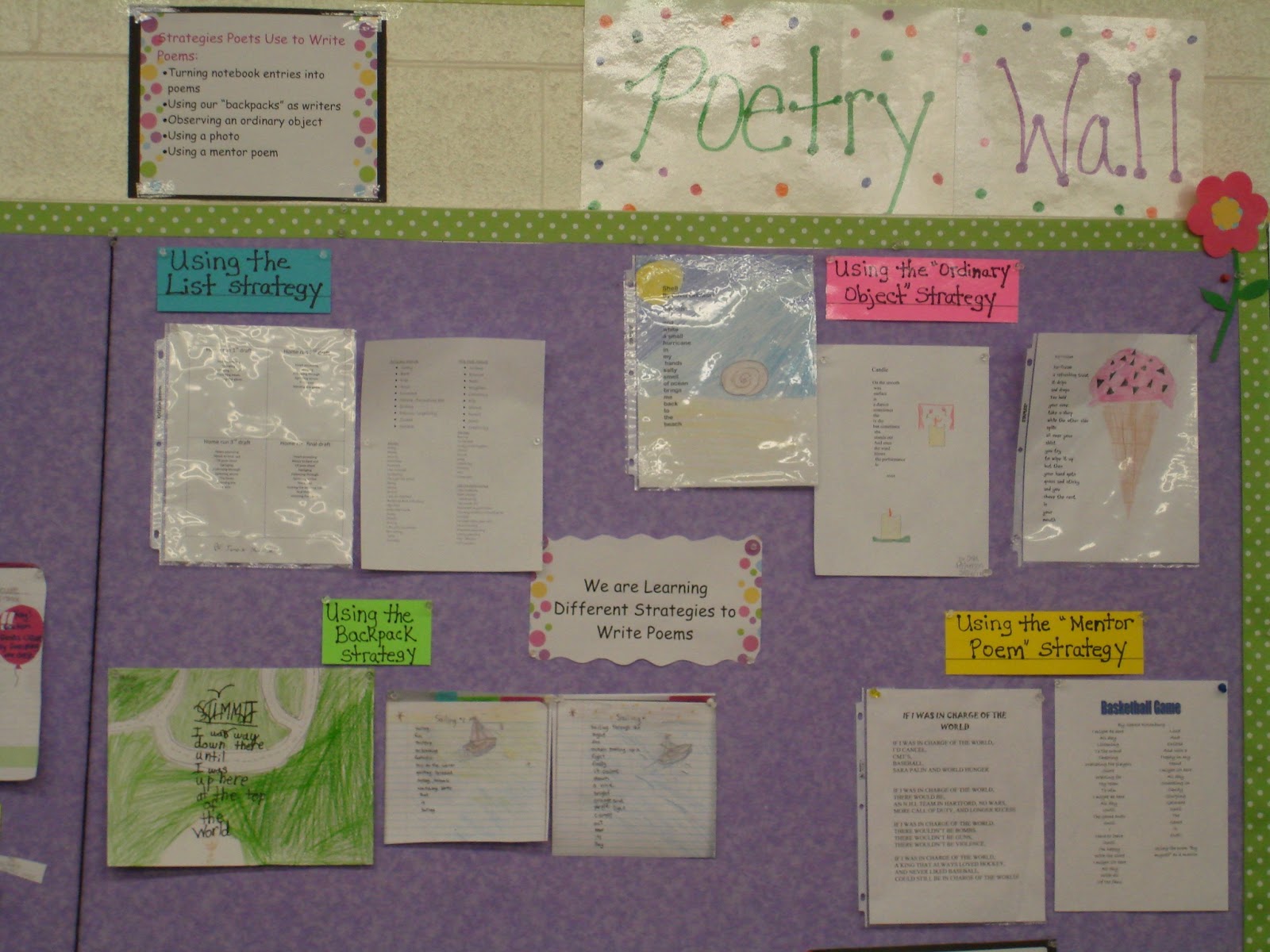
Recently, I had a conversation with my class about our bulletin boards for our upcoming units which are Poetry in writing workshop and Social Issue Book Clubs in reading workshop.  I had students discuss at their tables how they envision using our bulletin board spaces for these upcoming units, along with still displaying their work in their reader’s notebooks.  Each table had a thoughtful conversation and impressed me with their ideas of how to use the space for their own learning and work.  The joint decision was that we would use the writing bulletin board to display their poems by posting them under the strategy heading that they used to write the poem (turning a notebook entry into a poem, observing an object, using a photo, making a list, using a mentor poem).  They decided that we would divide our reading bulletin board space into five sections, giving one section to each book club group to use to display their thinking and share strategies they are using during their book club conversations.  Last, but certainly not least, they pleasantly surprised me by deciding that they wanted each table to get their own foam board to use to create their own “mini-bulletin board” to display ways they are using their reader’s notebooks.  I was so excited to hear this and will be making a trip to a store tomorrow to purchase foam boards for each table!  I will share photos as soon as they create their mini-bulletin boards! 

Poetry Bulletin Board to display student poems according to which strategy they used
Happy Reading and Writing! :)

Tuesday, March 6, 2012

Power of Read Aloud Part 2

Reader's Notebook Bulletin Boards and Foam Boards:
I give students the ownership of deciding how they would like to organize and deepen their thinking about texts in their reader’s notebook.  Of course, I model various strategies to use throughout the year so students can choose from the ones I have modeled or create their own way of responding to texts.  I have a bulletin board in the classroom all year titled “Ways We are Using our Reader’s Notebooks” so students can not only share the strategies they are using with their classmates, but they can also learn from their classmates.  The students make the copies of charts and/or responses and post them on the bulletin board along with a card that has their name and the name of the strategy they used (students name the strategy themselves if we haven’t already decided on a name as a class). 


I also use foam boards (a strategy I learned from Ann Marie Corgill and Franki Sibberson years ago) to display student examples of how they are using their reader’s notebook and examples of charts/responses students can use as a model.  Last year, I had a group of students create a foam board displaying how they can create a “Quote Web” by choosing one important quote from the text to write in the center and then branch out from the quote with their thinking about it.  This was one strategy they shared with their classmates to show the importance of quotes and how they can deepen your thinking about the characters and the book as a whole. 


Celebrating and Sharing Reader's Notebooks through Gallery Walks:
Another way to honor students’ thinking in their reader’s notebooks and learn from one another is to have Reader’s Notebook Gallery Walks once a month.  For this learning celebration, students put their reader’s notebook on top of their table along with either a piece of paper labeled “Comments” or a stack of post-its for classmates to use to write comments.  Students can either mark certain pages in their notebook that they want their classmates to read or can flag an entire section such as the Read Aloud section.  Students walk around the classroom, sitting down to read their classmates’ notebooks and leaving positive comments about the strategies they are using.  After being able to have students view about 4 or 5 classmates’ notebooks, we gather as a whole class to share and honor the strategies they saw their classmates using.  This share honors students, encourages them to reflect, and helps them set goals for themselves for which strategies they can try using in their reader’s notebook. 

Happy Reading & Writing! :)


Monday, March 5, 2012

The Power of Read Aloud Part 1

One of my strongest passions as a teacher is read aloud.  To me, read aloud is the heart of literacy in the classroom and empowers students as critical thinkers about books. It not only teaches students important reading skills to be life-long readers, but also strengthens partner and whole class conversations as well as writing about reading. 
I am going to be posting a series of posts about read aloud for the next couple days so stay tuned for more!  Some of the topics I will post about are:  Read Aloud Charts, Whole Class Conversations, Reader's Notebooks, and much more. 

Part 1:
Read Aloud Timeline 
We have a read aloud bulletin board in our classroom where we create a timeline of our read aloud covers to help us make connections across texts throughout the school year.  The visual of seeing the covers helps students spark memories of their thinking so they can make meaningful connections and notice patterns across the texts during our units of study in reading workshop. 


Personalizing Readers Notebooks and Creating Sections
During read aloud, students are engaged through turning and talking to their reading partners, stopping and jotting in their readers notebooks, and adding their thinking to our class charts.  I am a firm believer that students put in more effort and are invested when they feel a sense of ownership as learners in the classroom.  To create a sense of ownership in my students, I have them personally decorate their reader’s notebooks with titles, authors, book covers, thinking stems, quotes, etc.  By personalizing their reader’s notebooks like they decorate their writer’s notebooks, I find that they are more apt to take pride in the charts and responses they develop about their texts and read alouds.  In addition to personalizing the outside of the notebook, they also create sections within the notebook.  All students have three sections with tabs labeled: Read Aloud, Independent Reading, and Reflections.  In addition to these three sections, students can decide if they want to create other sections such as a section to collect quotes, titles of books to read next, or a strategy section.  These sections not only help with organization, but also teach students how to reflect on themselves as readers and create a purpose for writing about their reading.