Showing posts with label mentor texts. Show all posts

Monday, June 29, 2015

It's Monday! What Are You Reading?


Jen Vincent at Teach Mentor Texts and Kellee Moye and Ricki Ginsburg at Unleashing Readers cohost It's Monday! What are You Reading? weekly on their blogs.  To see what others are reading and recommending each Monday, or to participate, be sure to head over to these blogs.

I read A Handful of Stars by Cynthia Lord in one sitting, and another round of thanks to Tara Smith who wrote about this book at her blog,  A Teaching Life. (I had my last week's book from Tara, as well.) I am now reading it a second time out loud to my daughter  and picking up on details and craft moves that I hadn't noticed when I was whipping through to see what would happen. Cynthia Lord's text structure and plot development is simple, but her messages and the snippets of information she tucks into her words are complex and great opportunities for close reading. Cecily and I had a great discussion about the importance of using the word "that" instead of "the". Not every book is a springboard for that type of discussion. In many ways, Cynthia Lord reminds me of Patricia MacLachlan in the ways that she delves into tough situations for children, and creates meaningful changes that we can all learn from. 

Inspired by Fran McVeigh who wrote about her experiences at Teachers College last week on her blog, Resource-Full, I have been re-reading and re-reading Henry and Mudge and the Happy Cat by Cynthia Rylant. (If you didn't read Fran's posts throughout the week, I highly recommend heading over to her blog with a cup of coffee, as she has shared some amaxing learning.) Really, there are so many craft moves tucked into this small book that can benefit writers across the elementary grades and beyond. As a writer, this book is a seminar for me on the power of threes. Read it and pay attention to how many times Cynthia Rylant uses three in her text. There is also clear and focused plot development, character development, conflict, and closure which again, will help all writers develop their own story arc. I have marked up this book, covering pages with color-coded sticky notes, as described by Fran.

In the near future, I will write a detailed blog post about The Unstoppable Writing Teacher by M. Colleen Cruz. I have been reading, re-reading, and marking up this inspiring book. There are parts where I feel like Colleen Cruz is having a conversation with me, and is speaking directly to some of my hopes and dreams, and anguish and concerns about writing instruction. She includes helpful resources throughout the book including letters to families, charts for observations, surveys for students, and lists of mentor texts. (Those are only the tip of the iceberg of resources in this book.) It's easy to read, even though it's packed with information, and the resounding message for me throughout this text? Write. Be a teacher of writing who struggles, understands, and celebrates the process. If you are debating this book in your cart, hit the order button. You'll love it. 

Happy reading,


Monday, June 1, 2015

It's Monday! What Are You Reading?


Jen Vincent at Teach Mentor Texts and Kellee Moye and Ricki Ginsburg at Unleashing Readers cohost It's Monday! What are You Reading? weekly on their blogs.  To see what others are reading and recommending each Monday, or to participate, be sure to head over to these blogs.

Over the summer, I will be working on our first-grade nonfiction writing unit. One of the requests from teachers was to have some titles of mentor texts with interesting introductions and conclusions. I spent time in the library and with our media specialist collecting some titles with a variety of beginnings and endings. 


Tooth and Claw by Jim Arnosky is a book that could me a mentor text in upper grades. It is full of linguistic craft moves--images, figurative language, varied sentence structure, comparisons--but the introduction is an example of an anecdote. Jim Arnosky tells the story of how a tiger let a little boy pass by, giving him luck.

An easier way for students to begin information books, especially when they are writing about animals is with a chronological beginning. Tale of a Tadpole by Karen Wallace is an excellent example of this strategy. Written at a low enough lexile level for many first-graders, this book begins with "The tale of a tadpole begins in the pond." Predictably, it ends when the tadpole becomes a frog.


Frogs: Nature's Friends by Ann Heinrich would be a great pairing with the Tale of a Tadpole, and it begins with a frog noise and a splash into the pond. This is a great mentor text for beginning with a sound hook.


I have to say that even the cover of Snakes by Melissa Stewart could lead to some interesting observations. At first glance, I thought the cover was scary and that the mouth of the snake was wide open, but then I realized that it was a picture of the snake's skin shedding. As a mentor text for interesting beginnings, this book hooks readers with a series of questions written in rhyme.


Owls by Aaron Carr begins with the simple sentence "Meet the owl." It then goes on to talk to readers hypothetically throughout the text, as if they might meet an owl.  I could see young information writers being able to emulate this style, developing their voice and sentence structure.


I love prowling low lexile nonfiction texts for examples of unusual beginnings and endings. An earlier post that I wrote when I was working with third-grade teachers is linked here, featuring a collection of books and creative ways to end information books. If you have any favorite mentors for nonfiction beginnings and endings, please share!

Happy reading,


Monday, May 18, 2015

It's Monday! What Are You Reading?


Jen Vincent at Teach Mentor Texts and Kellee Moye and Ricki Ginsburg at Unleashing Readers cohost It's Monday! What are You Reading? weekly on their blogs.  To see what others are reading and recommending each Monday, or to participate, be sure to head over to these blogs.


I was in the library this afternoon looking for some books that would inspire students during our summer writing academy when I got distracted by the Woodson books on the shelves. I love Brown Girl Dreaming, and Each Kindness, but I had never read some of Jacqueline Woodson's other books. I sat down and read one of them right on the spot. Honestly, Our Gracie Aunt took my breath away. I knew that Jacqueline Woodson writes emotional books, but I wasn't ready for the power of this picture book. I found myself welling up right there on the library floor. This is a book that I would use to teach turning points to young readers and writers, as the emotional arc in the story is intense. 

 I brought some of Jacqueline Woodson's other books home with me, so that I could cry in a less public setting. 

What a beautiful book Coming on Home Soon is! While it would be a wonderful addition to a text set about African American's roles in wars, it is also an amazing book for teaching craft moves in narrative writing. For example, there are shifts in time, as the book is written in the present tense with memories and flashbacks woven in throughout the text. Also, Jacqueline Woodson is a master at using fragments effectively. On the first page, she writes:
Mama's hands are warm and soft. When she put her Sunday dress into the satchel, I held my breath. Tried hard not to cry.
I would love to talk to students about how that last sentence is so powerful, not only for the meaning, but also because of the use of a fragment. E.B. Lewis illustrated this book, and did an amazing job at capturing the story and suggesting what might be happening with the artwork. I could envision powerful conversations emerging from the secondary storyline that exists in the illustrations.

If you are trying to teach students how to capture dialogue and details of a place, We Had a Picnic This Sunday Past has fabulous examples and mentor passages. I loved the line "Grandma says Martha should be in any room but the kitchen." What an amazing job of holding on to the funny things people say and then re-creating them in a book Jacqueline Woodson does.

And then Show Way is a book that I will return to again and again. I'm planning to sit down with a pile of post-its and mark it up for the power of images--, the power of listing things in a series--stars and moons and roads--, the power of repetition--Loved that baby up so. Yes, she loved that baby up...If you have never read Show Way, I highly recommend it for both the incredible prose and the beautiful artwork by Hudson Talbott. Just have tissues close by.

Happy reading!

Monday, May 4, 2015

It's Monday! What Are You Reading?


Jen Vincent at Teach Mentor Texts and Kellee Moye and Ricki Ginsburg at Unleashing Readers cohost It's Monday! What are You Reading? weekly on their blogs.  To see what others are reading and recommending each Monday, or to participate, be sure to head over to these blogs.

Each summer, we offer a Summer Writing Academy for students who love to write. We organize and plan the academy with specific themes in mind, and this year, we are planning to emphasize the power of story in relaying opinions and messages. Additionally, we will study mentor texts that celebrate people and places, and I am predicting that many of our students will write some wonderful pieces along the lines of When I Was Young in the Mountains by Cynthia Rylant, one of my all time books and one that celebrates the magic of a place. 

Today, I spent some time in the library looking for and rereading books that contain opinions, as well as books that celebrate people or places. 

I'm guessing that most of you have read Each Kindness by Jacqueline Woodson, but it was wonderful to read it and think about it as a book with a strong opinion that so many children share. We should all treat each other with kindness is a popular claim for elementary opinion writing, but Each Kindness is a beautiful example of how narrative writing can express that claim.

Along similar lines is Roller Coaster by Marla Frazee. We usually use this book as a mentor text for teaching students about the power of small moment stories, but this book also has an opinion about trying new things that is embedded within the story. I forgot about The Wednesday Surprise by Eve Bunting as a book we could since it is such a beautiful narrative about never being too old to learn something new. 

Sometimes opinion writers can write essay-like pieces to celebrate people and places, but we can also express those opinions with narrative pieces. Sweet, Sweet Memory by Jacqueline Woodson, My Great Aunt Arizona by Gloria Houston, What You Know First by Patricia MacLachlan, and Wilfrid Gordon McDonald Partridge by Mem Fox are all books that I am looking forward to using as mentor texts for celebrating places and people. (And don't forget When I Was Young in the Mountains!)

Dr. Seuss is an author who embeds strong opinions, and his work will definitely find a place in our Summer Academy. If you have some other favorites or suggestions, please share!

Happy reading!


Monday, April 27, 2015

It's Monday! Here's What I'm Reading


Jen Vincent at Teach Mentor Texts and Kellee Moye and Ricki Ginsburg at Unleashing Readers cohost It's Monday! What are You Reading? weekly on their blogs.  To see what others are reading and recommending each Monday, or to participate, be sure to head over to these blogs.

Good news: This post is not going to be an expensive one to read...

Last week, I was involved in a professional discussion with teachers about the challenge of finding mentor tests for opinion writing. We came up with a few picture books that demonstrate some craft moves-- I Wanna New Room by Karen Kaufman Orloff and illustrated by David Catrow,  Dear Mrs. LaRue by Mark Teague, Earrings by Judith Viorst and illustrated by Nola Langner Malone... However, as much as I love these books for their humor, voice, and structure, they don't provide the mentoring that would really help fourth-grade and up students see what they need to do in order to write high impact opinion/argument texts.

I spent some time reading on-line pieces, and I was really excited to find change.org. I HIGHLY recommend this website for appropriate, engaging, relevant letters that can be analyzed for craft moves, structure, and elaboration. For example, there is a letter petitioning McDonalds to offer healthier alternatives, and I am including just one paragraph of the letter:

Adding plant-based protein options at McDonald's will appeal to workers out for a quick lunch, families with health-conscious members out to dinner, children on field trips, and anyone looking for something different than the current menu at McDonald’s where even the french fries contain beef flavoring (they don't in Europe, incidentally)! According to a recent survey, more than one-third of Americans already buy meat substitutes for reasons that range from health to ethics! So why not make a meatless option available at one of America’s favorite restaurant chains for everyone to enjoy? Healthy living should be about progress, not perfection, and this is an easy step that McDonald’s could be taking. 
(https://www.change.org/p/mcdonald-s-it-s-time-for-a-healthy-meatless-option)


 This passage could be used as a demonstration text to inspire students to:

  • use punctuation deliberately for voice and reader engagement
  • include statistics and facts to strengthen an opinion/argument
  • state a clear claim that aligns with reasons and evidence
Change.org has TONS of letters and petitions ranging from G/PG rated ones to more provocative, controversial issues. I am sure that you will find examples of opinion writing that will strengthen your workshop instruction across elementary grades and into middle school, as well!

Happy reading,


Sunday, April 12, 2015

Working With Strong Writers

Throughout the year, I have had several teachers ask me about working with their stronger writers. I am always happy to talk about this topic. Here are a few ideas for working with this population of young writers:

  1. Use mentor texts. Develop a cache of go-to writing for your units and mark them up so that students can study craft moves. Specific annotate pieces, either in the margins or on the pages with Post-its so that students have a visible representation of what the craft move is and what it looks like. Challenge these students to try out the craft moves in their own writing. Some go-to mentor texts, broken down by genre include:
    1. Narrative:
      1. Anything by Cynthia Rylant, Patricia MacLachlan, Eve Bunting,or Kevin Henkes.
      2. For small moments, Roller Coaster by Marla Frazee, Fireflies by Julie Brinkloe, and Owl Moon by Jane Yolen.
    2. Information:
      1. I love the nonfiction books that Nicola Davies writes, because she includes such beautiful language and craft moves for hooking and interesting readers.
      2. Any of the National Geographic publications because they all feature catchy introductions and conclusions with an assortment of text features.
    3. Opinion
      1. I am constantly on the hunt for editorials and debate examples that I can share with students. Lego’s recent debate about whether to market pink Legos spurred some great writing of strong opinions about this topic.
      2. Youtube videos of persuasive speeches. Whatever craft moves work in speeches typically works in writing.
      3. Martin Luther King’s speech, I Have a Dream, is full of powerful strategies for opinion writers--repetition, images, personal stories, emotional references all appear in this historic speech.


  1. Develop or obtain grade level checklists for each genre- narrative, information, and opinion/argument-- and make them student friendly. Writing Pathways by Lucy Calkins is an incredible resource for student-friendly, genre-specific, spiraling checklists.

If you don’t have access to this book, study the Common Core State Standards and develop some checklists that show progressions for students. For each type of writing, subtle difference ramp up the level and sophistication of writing.
Once students learn to use these checklists or progression ladders, they can study the nuances that exist between grade level, as they move of the ladder of writing sophistication. Students who excel at writing will be inspired to set and meet goals in their written work.

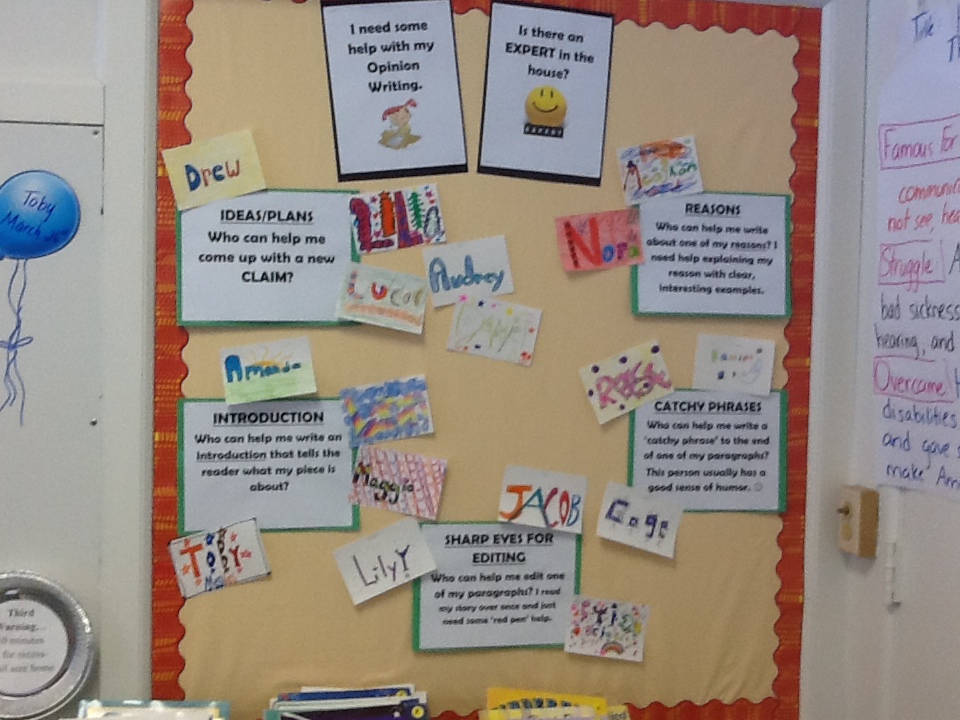
  1. Set up seminars for students. Even students in lower elementary grades will like the concept of signing up for seminars, since even the name sounds collegiate and high level. Better yet, enlist some of your strong writers to become “experts.” Perhaps they can apply for expert status, by demonstrating the skill or presenting evidence of the skill in their work. It’s never too early to teach students skills that are involved with job applications. The picture below is of a bulletin board in a third-grade classrooms. The “experts” are thrilled to continue to develop their skill and feel a strong sense of responsibility to do so, while their peers enjoy learning from other students. Meanwhile, the classroom teacher is freed up to work with more students.

Lisa's wall.jpg


4.   If you teach genre-specific units, encourage strong students to try to write in a different genre. For example, students can write a story to illustrate an opinion or  to prove a point. Here’s a potential example:
One day, I was left at the soccer field. All around me, my friends left, but no one realized that I didn’t have a ride home. If only I had a cell phone...

Narrative is also a powerful genre for teaching readers. High functioning writers who have met the standards of information writing might really enjoy the challenge of embedding information into a narrative piece along the lines of a biography or a Little House on the Prairie episode. If you are comfortable with poetry, encourage writers to use poetry for any of the genres.


Hopefully, somewhere in this post, you will find an idea that inspires you to challenge some of the children in your classroom who are brimming with writing enthusiasm.

Happy Writing,

Tuesday, January 6, 2015

Slice of Life- Exploring a fabulous mentor text

Thanks to Stacey, Dana, Tara, Betsy, Anna, and Beth, the amazing writers and thinkers who host the Slice of Life community every Tuesday. Everyone is welcome to join with posts or comments at twowritingteachers.wordpress.com!


Our fourth-graders are getting ready to start their information writing unit. Instead of a classic writing workshop lesson, I co-taught a lesson today where their teacher read them one of my favorite mentor texts, It's All About Me-ow by Hudson Talbott, and I wrote down what I noticed that the author did as an information writer.

As the classroom teacher read, I jotted down what I noticed about the book, but I purposely stayed just behind the teacher as he read. That way, some of the students felt like they "noticed" first, while some of them "noticed" because I did. Either way, every student was engaged and they all have a list of craft moves  in their writer's notebooks that they are excited to try in their own information books.

I did not expect to notice over twenty-five craft moves, or I might have written smaller:


That being said, I think that it's really important that we don't obsess with having perfect charts. I loved the fact that the entire left-hand column is added because of what the students noticed and I missed. They were so proud of themselves!


I highly recommend Hudson Talbott's book as a mentor text for information writing because he does such an amazing job of including information with humor, voice, figurative language, and text features. The students loved the story and the craft moves--I can't wait to see what they write!

As new units begin, I also recommend having this sort of inquiry with any unit at any grade level. Read an appropriate level mentor text, especially one that the class has already read. Talk about the craft moves, the impact, the reasons that the writing piece works.  This chart, admittedly messy but created together, will serve the students well throughout their unit as a source of inspiration for their own information pieces.

Happy Slicing!


Monday, July 14, 2014

It's Monday! Here's What I'm Reading!


Jen Vincent at Teach Mentor Texts and Kellee Moye and Ricki Ginsburg at Unleashing Readers cohost It's Monday! What are You Reading? weekly on their blogs.  To see what others are reading and recommending each Monday, or to participate, be sure to head over to these blogs.

I love the time that summer offers for reading. This summer, I have been working on a chapter book, so my reading choices have been ones that have been serving as mentors. Patricia MacLachlan remains my favorite writer because of the simple language that contains complex information and meanings. Cynthia Rylant is another favorite for the humor and voice that she weaves into her writing.

I re-read The Truth of Me by Patricia MacLachlan. Although it is a first-person narrative, I was studying it for character complexity. If you have missed this book, it's a more recent one from Patricia MacLachlan, with a characteristic artist, a charismatic pet, an an eccentric older person. I highly recommend it!


I also picked up Patricia MacLachlan's The Boxcar Children Beginning. This book is a prelude to the classic series created by Gertrude Chandler Warner, imagining the events that led to the four Alden children living in a boxcar. While my chapter book is not a precursor to any famous series, (that's way too original and creative idea for me to have thought up) the character development and the sense of impending doom intrigued me as a writer reading this relatively short chapter book.


I spent time re-reading The Turtle from The Lighthouse Family by Cynthia Rylant. In this book, even though it is imaginative fiction, I used it to study how one event drives the story forward. I loved the relationships that were evident throughout this, and may go back to study how Cynthia Rylant includes snippets of information to inform readers about important prior events in the characters' lives.

Not so much for mentor-me reading, I finally got to Prisoner B-3087 by Ruth Gruener, Jack Gruener, and Alan Gratz. Melanie Swider's class chose it as their book of the year, and I can see why, since this book is a painfully gripping, and disturbing account of a young man's will to survive the atrocities of persecution, abuse, and torture in concentration camps. Based on the true events of Jack Gruener's life, Prisoner B-3087 provides a lens into some of the most despicable behavior of humans, and could inspire students to want to learn more about an era that should never, ever be repeated.

Currently, I am reading The Meaning of Maggie by Megan Jean Sovern. I am admiring the voice, humor, insight, and determination of the main character and narrator. I am sure that I will have more to say about it next week--thank you to all of the bloggers who have been raving about this one--I'm so glad I ordered it!


Because I am writing a lot, my professional reading has suffered. Stay tuned for next week, as this is a goal for the week!

Happy reading!


Thursday, April 17, 2014

Finding the Heart of Nonfiction--Such a Powerful Book!

I have been meaning to write a post about Finding the Heart of Nonfiction by Georgia Heard for a few months, but a couple of issues have gotten in my way. First, I want to really do her work justice as it is one of the most useful books for writing instruction that I have ever read, but second, and more importantly, I have loaned it to several teachers over this time and their feedback has been so positive and so grateful that I have not wanted to ask for its return. One teacher, whose student just won a state contest for her entry on nonfiction, said, "this book changed my teaching life."

Georgia Heard spends the first part of the book really breaking down what a mentor text is and what is involved to use mentor texts meaningfully in the classroom. Regardless of whether we are talking about fiction or nonfiction genres, she writes about what mentor texts are, why to use them, how to choose them, and then how to use them with students. She offers suggestions for mini-lessons, inquiry lessons, and even provides note-taking templates, as well as several examples of student work and evidence of student learning. I was truly hooked by this book on pp 22-23 where there is a Try This exercise, suggesting the use of different lenses to read two different texts about seahorses. One is a wiki.answers entry and one is from Sea Horse: The Shyest Fish in the Sea  by Chris Butterworth. Both of these texts give important information about seahorses, but the latter is full of figurative language, imagery, and precise words. What an incredible lesson for teaching students the value of beautiful words, even--no especially!--in nonfiction!

In the second part of the book, Georgia Heard provides a chapter for each of seven nonfiction craft tools: focus, turning facts into scenes, leads, points of view and voice, precise language, text structures, and endings. Since I have read this book, I have had opportunities to develop some units and to coach teachers and students to use some of the strategies in this chapter and trust me, they are effective!

FOCUS: She uses the analogy of the hearth because it is "a place in a home where family and friends come together to warm and comfort themselves. If we think of focus in writing in the same way--the hearth of a piece of writing around which all the details and words gather--it's a helpful metaphor. " (p. 41) LOVE THIS!

Specific, creative strategies follow to help young writers focus topics with suggestions for mentor texts, teaching ideas, and writing tips. I especially love the idea of helping students to focus their nonfiction writing by developing a poem about it. Because poetry does not explicitly have a place in the Common Core States Standards, I am always looking for ways to weave it into units and what a meaningful strategy!

TURNING FACTS TO SCENES: One of the most memorable parts of this book for me is on pp. 52-53 where there is an excerpt about tarantulas from Jean Craighead George that is packed full of not only knowledge and facts about these spiders, but also of description, narrative techniques, figurative language and precise words. Because Georgia Heard gives exercises for more and less experienced writers, there are choices for teachers to use as examples with students to give them practice in turning facts into Jean Craighead George-like texts. Like poetry, voice does not explicitly live within the words of the CCSS, but descriptive language does!  And this chapter visibly demonstrates the progression of good writing to great writing.

LEADS: I love teaching leads, since this is the quickest way to hook or lose readers, and the tips, ideas for charts, examples and exercises found here are inspiring. We used some of the ideas in our fourth-grade informational writing unit and our students loved having a repertoire of leads. We developed charts that presented the information on p. 61. Now, as students are moving into their research-based essay unit, they are transferring their knowledge about leads!

POINT OF VIEW AND VOICE: This chapter is seven pages long and the pages have plenty of white space, but there are SO MANY ideas and SO MUCH knowledge to present students. Students should understand the differences between first person, second person, third-person objective, and third-person omniscient. There are suggestions of how to present this information and then for how to inspire students to try out different techniques within their own writing. Our students really enjoyed writing letters from the perspectives of different famous people in their information books, a lesson that was inspired from these pages. When we think about the importance of writers understanding audience, these are powerful pages.

PRECISE LANGUAGE: As I stated earlier in this post, voice does not explicitly live within the CCSS, but when writers use sensory words, precise nouns and verbs, figurative language, and domain-specific vocabulary, voice emerges. One of the exercises in this chapter is to guess whether there are more concrete nouns, active verbs, or adjectives in a given passage. If you want an engaging activity to use to help students understand the power of nouns and verbs, as opposed to juicy adjectives, check out p. 81! I also love that Georgia Heard presents lists of words to avoid: things, stuff, beauty, niceness, glory, devotion.

The chapter about precise language is the longest of the seven chapters, and I'm not going into all of the details of it. Suffice it to say that there are several lessons, strategies, exercises, student samples, writing tips, and even games that jump off these pages and would help any level teacher provide engaging instruction about language and the importance of words.

TEXT STRUCTURES: I have thought of text structures as a relative strength in our curriculum, but I still found plenty to learn in this chapter. Again, there is a framework that wants to jump out of the book and on to a chart for student use in the classroom. There are also strong and clear links to the CCSS for both readers and writers, since the Standards emphasize that students study and learn about craft and structure.

ENDINGS: I see a lot of endings that go something like: "That's my book about...I hope you liked it." Do these endings give the sense of closure that the CCSS require? I'm not sure, but they definitely don't give me the sense of closure that I want! Finding the Heart of Nonfiction includes specific strategies for getting students to develop endings that are more satisfying--circular endings, question endings, chronological, quotation, and reflective endings... There are descriptions, strategies, examples, and reproducibles for of all of them.

Without the bibliography and index, Finding the Heart of Nonfiction is 123 pages long. The font is average and there is plenty of white space on many of the pages. However, it changed the way I think about the instruction of any sort of nonfiction writing. I know that my post is longer than usual, but I hope that it has inspires you to find yourself a copy.


Tuesday, March 26, 2013

Poetry Writing in Our Classroom

One of my favorite writing units during the year is our poetry unit and students always enjoy it too! For the past couple weeks, we have been writing lots of poems using a variety of strategies.  I like to teach and model various strategies to give students a whole "toolbox" of strategies they can choose from as they write their own poems.  Below you will find two of our class charts listing the strategies I have been modeling so far and that students have used in these two weeks.  


During each mini lesson, I first model how I used the strategy to write my own poem and then we work as a whole group to write a class poem using the strategy, during the active engagement part of the mini-lesson.  Students have been using Google Drive to write their own poems and love sharing them with their writing partners and with me to get feedback/comments.  Students have all created a poetry folder within their writing folder in their digital portfolio on Google Drive and have a large collection of poems using a variety of strategies.  

Bulletin board where students share their poems - they pin them underneath the type of strategy they used as a poet

Bulletin board displaying poems students wrote about an important photo 

Stay tuned to hear more about our poetry writing during this unit! :)

Tuesday, February 19, 2013

10 of My Favorite Nonfiction Books for the Nonfiction Picture Book Event #nf10for10


Thank you Cathy Mere (Reflect & Refine), Julie Balen (Write at the Edge), and Mandy Robek (Enjoy and Embrace Learning) for hosting this Nonfiction Book 10 for 10 Event (#nf10for10)! Cathy and Mandy have hosted the Annual Picture Book 10 for 10 Event for the past three years and this is their first Nonfiction Event.   Please check out their blogs to read about everyone's favorite nonfiction books!

I love nonfiction books so coming up with only 10 of my favorites was a challenging task for me and I had to leave some favorites off the list.  Here are 10 nonfiction books that I read aloud each year in 5th grade to support our nonfiction unit of study and other units in both reading and writing workshop:

Elephants Can Paint Too! by Katya Arnold is always a favorite in our classroom.  I love how one side of the page tells a narrative story about elephants painting, while the other side of the page gives interesting facts about elephants.  It is a great example of a hybrid nonfiction text that includes narrative and expository structures.  The facts about elephants in this text are amazing and you are guaranteed to learn new information about elephants that you never knew!


Oh, Rats! by Albert Marrin and C.B. Mordan is a fascinating text about rats that is written in a multi-genre format. There are various passages in this text that range from narrative to expository formats and the points of view vary also.  It is a great text to use when teaching students different forms of note-taking and how to decide which form to use for different texts.  For example, some passages compare two different rats so it would be a great passage to use to model using a venn diagram or t-chart for note-taking. It is also a perfect mentor to use during writing workshop throughout the year for different purposes and students love to hear about rats!

Should There be Zoos? By Tony Stead is my all-time favorite nonfiction and persuasive text to read aloud to students during the nonfiction unit. The arguments for and against zoos are research based and alternate throughout the text.   The students love stating their opinion about zoos at the beginning and then revising after learning more about the research behind each argument.  We also have debates to share our opinions and beliefs while reading and discussing the text.  This is also a perfect text to use as a mentor during writing workshop for argumentative research-based writing!


Winter's Tail: How One Little Dolphin Learned to Swim Again by Juliana Hatkoff, Isabella Hatkoff and Craig Hatkoff is a powerful and inspirational nonfiction text.  A couple years ago, one of my students chose to research Winter during our nonfiction unit and she shared her learning with the class.  We were all very interested in the topic so we read the book and also watch parts of the movie too - kids loved it!  It has been a class favorite ever since!
I love all of the Hatkoff's books such as Owen & Mzee and Knut - they are all must reads!


Nubs: The True Story of a Mutt, a Marine, and a Miracle by Brian Dennis and Kirby Larson and Mary Nethery is an inspiring true story that is a must read!  Last year, my class awarded this book as the Best Nonfiction Book of the Year for our class awards at the end of the year - they loved it!  This years class equally loved it and were all very inspired and touched by this story about Nubs, an Iraqi dog of war who never gave up on making his home with the Marine Major Brian Dennis.


Tarra and Bella: The Elephant and Dog Who Became Best Friends by Carol Buckley is a powerful narrative nonfiction text!  Tarra, an elephant, becomes best friends with Bella, a stray dog.  Even though they are complete opposites in more ways than just size, they form a close friendship that is inseparable no matter what happens.


All of Seymour Simon's nonfiction books are amazing! One of my many favorites of his is Wild Babies.  Each double page spread focuses on a different animal from elephants to opossums to kangaroos and so on.  It is a perfect book to teach how to use boxes and bullets for note-taking, summarizing, and determining importance.  I use this text constantly throughout the year for mini lessons in both reading and writing workshop.

I love all of Melissa Stewart's nonfiction books! Shark or Dolphin? How Do You Know?  is one of the many titles in her "How Do You Know?" series that includes topics such as: Butterfly or Moth?; Frog or Toad?.  This series is perfect for teaching students how to read nonfiction texts written in a comparison structure and are also great to model note-taking strategies, such as a T-chart or venn diagram.  I also love her book, National Geographic Readers: Deadliest Animals.  It engages the reader right in the introduction with the surprising fact that the African Lion is not actually the deadliest animal and there are many surprising deadly animals.  

I love all of Bobbi Kalman's nonfiction books and one of my favorites is A Koala is not a Bear.  It is full of colorful photos, labeled diagrams, headings, boxed information, bold words, sections, maps, and more.  It is a great text to teach how to take notes using boxes and bullets and also comparison forms such as venn diagrams and t-charts.  
I recommend all of Nicola Davies' nonfiction books - they are all amazing!  Surprising Sharks and One Tiny Turtle are two of my favorites.  They are both great examples of hybrid nonfiction by including narrative and expository structures and features.  Surprising Sharks is full of colorful illustrations, labeled diagrams, and compelling facts that will captivate readers.  It is full of surprising facts that end up proving at the end that sharks should probably be more afraid of humans than we should be of them.  


I also love the Sports Illustrated Kids: Game Day series by Clay Latimer.  My favorite book in the series is VIP Pass to a Pro Baseball Game!   I am a baseball fan (Yankees, of course!) so I enjoyed reading about the "behind the scenes" action that we don't see watching the games - the pre-game and post-game action.  I learned many new facts about the umpires, coaches, and groundskeeper along with information about the bullpen, dugout, and the clubhouse.  This is a favorite series in our classroom this year!  I am always looking for mentor texts to use for informational writing and this is a perfect series to use to study craft in informational writing.

There are many, many more nonfiction books that are my favorites and wish I could have added them to this list (as it is, I may have snuck in an extra for good luck! ).  Seymour Simon, Nicola Davies, Melissa Stewart, Bobbi Kalman, and the Hatkoff's are some of my favorite go-to authors when I am seeking out nonfiction texts - I highly recommend all their books! 

Thank you again Cathy Mere and Mandy Robek for hosting this nonfiction book event!  I look forward to learning about new titles from others and expect it to be an expensive day for buying more nonfiction titles to add to my already extensive collection! :)

Happy Reading! :)