Last year I read Opening Minds and Choice Words by Peter Johnston and participated in the #CyberPD online discussion about Opening Minds - click here to read my posts. After reading the book and discussing it with others online, I told myself that I was going to eliminate comments such as, "Great!"; "Good job!"; "Excellent!"because they are types of praise that are not specific and do not promote learning. I know most of us can probably admit to using these comments in our classrooms at some point. I am probably still guilty of using them, even when I vowed not to after reading Opening Minds. I try to always be aware of my word choice and catch myself, but I may still use them without even noticing.
For the past few weeks, I personally experienced what it feels like to be on the receiving end of these comments because my pilates instructor uses them in her classes. Each week, I go to pilates reformer classes at a nearby studio and as my pilates instructor walks around during class, she frequently says, "Perfect"; "You got it"; "Great job"; "Good job". I didn't think anything of it until I received a "Good job" one day as she was near my reformer and then immediately said, "Perfect" to the woman across from me. I could not help thinking, "What is she doing better than me to make it 'Perfect', while I am just doing 'good'?" Another time, she said, "Perfect" to me as she was near my reformer and now I kept thinking, "I wish she told me what I was doing to make it 'perfect' this time so I can make sure to do it like that all the time!" Receiving these comments made me think hard about how these comments must make our students feel and think. This week, I paid even closer attention to my choice of words when giving feedback to students and did catch myself a few times - it is hard sometimes not to use these comments, but it is critical that we try to be more specific in our feedback.
We have to always be aware of the power our words have in the classroom and the meaning that is conveyed to our students. For example, in Opening Minds, Peter Johnston wrote, "Saying 'I'm proud of you' to someone has the same effect as saying 'I'm disappointed in you.'" This made me realize that when we say, "I like the way..." we are giving other students the impression that we don't like what they are doing and the feedback is in the form of a judgement. Also if we say, "Good job" to one student but then say, "Excellent job" to another student, how does that make the first student feel? I admit I am still faulty sometimes of using person-oriented praise and am going to continue to work extra hard to give productive feedback that is process-orientated in my classroom.
I am thinking of having an open conversation with my class this coming week about feedback/praise and ask them to reflect on what they feel and think about when they receive general comments like, "good job." I am also thinking of asking them to help me continue to become stronger in giving specific, process-oriented feedback by asking me, "What makes it good vs. great or perfect?" if I ever give them a comment like that. I want them to advocate for themselves and call me out on it because I want my feedback to help them grow as learners, instead of making them feel like they are doing something wrong because they received a "good job" when someone else was told they are doing, "great, excellent, or perfect."
I'd love to hear your thoughts and about any strategies you use that help you give specific feedback to students that is process-orientated instead of the general praise.
Two teachers who share the passion of literacy, teaching, and life-long learning
Showing posts with label cyberpd. Show all posts
Saturday, March 2, 2013
Saturday, July 21, 2012
Opening Minds #CyberPD Part 2
This is the second week of our #CyberPD conversation about Opening Minds by Peter Johnston. Thank you Cathy Mere for hosting last week's conversation on your blog. This week, we are discussing chapters 4-6 and Jill Fisch is hosting the event on her blog My Primary Passion - thank you Jill! Next week, Laura Komos will host our final reflection of the remaining chapters.
My Thoughts and Reflections from Chapters 4-6:
Chapter 4 resonated with me more than some other chapters because many of us can probably say we are guilty of saying, "Good Job" or "I like how..." and according to Johnston this is the opposite of the kind of feedback we should be giving children. I often hear teachers say, "I like the way..." or "I like how..." to try to build confidence and to encourage other students to correct their behavior. This kind of feedback, however, does not promote learning but is person-oriented praise rather than process-oriented praise which we want to give. Johnston's line on page 38 struck home when he said, "saying 'I'm proud of you' has the same effect as saying 'I'm disappointed in you.'" This made me realize that when we say, "I like the way..." we are giving other students the impression that we don't like what they are doing and the feedback is in the form of a judgement. Also if we say, "Good job" to one student but then say, "Excellent job" to another student, how does that make the first student feel? I admit I am faulty of using person-oriented praise at times and am going to work extra hard this year to give productive feedback that is process-orientated. I am going to take Katie Dicesare's idea of creating "cheat sheets" of some of this language until I fully internalize it.
Some of the language from these chapters that I may add to my "cheat sheets" are:
- "Look at how you..."
- "How did you...?"
- "Why do you think...?"
- "Could you think of other ways that would also work?"
- "You tried hard to..."
- "You can teach others..."
Some of the language I'm going to work hard to eliminate are:
On page 48 in Chapter 4, I love the line, "The purpose of feedback is to improve conceptual understanding or increase strategic options while developing stamina, resilience, and motivation - expanding the vision of what is possible and how to get there." I love how Peter Johnston suggests that we maybe call it feedforward instead of feedback - makes so much sense since our goal is to move students forward in their learning process.
Opening Minds by Peter Johnston has made me think of language in ways that I have never thought of before and I thank him for pushing my thinking about the way I talk to kids in new and better directions. This is a must-read book for all educators and it is a book that I will continue to reread and refer to often - I'm glad I have the e-book version so I have it with me at all times :)
To read more reflections about Opening Minds by Peter Johnston, please be sure to visit Jill Fisch's blog and Cathy Mere's blog. Laura Komos will be hosting #cyberpd next week on her blog for chapters 7-9.
- "Good job"
- "I like the way..."
- " I like how..."
On page 48 in Chapter 4, I love the line, "The purpose of feedback is to improve conceptual understanding or increase strategic options while developing stamina, resilience, and motivation - expanding the vision of what is possible and how to get there." I love how Peter Johnston suggests that we maybe call it feedforward instead of feedback - makes so much sense since our goal is to move students forward in their learning process.
Opening Minds by Peter Johnston has made me think of language in ways that I have never thought of before and I thank him for pushing my thinking about the way I talk to kids in new and better directions. This is a must-read book for all educators and it is a book that I will continue to reread and refer to often - I'm glad I have the e-book version so I have it with me at all times :)
To read more reflections about Opening Minds by Peter Johnston, please be sure to visit Jill Fisch's blog and Cathy Mere's blog. Laura Komos will be hosting #cyberpd next week on her blog for chapters 7-9.
Monday, July 16, 2012
Opening Minds #CyberPD Part 1
Thank you Cathy Mere, Jill Fisch, and Laura Komos for organizing this #CyberPD event schedule for Opening Minds by Peter Johnston. Please visit their blogs to read many powerful posts about Opening Minds and to find out more about this #cyberPD that is currently in process on blogs and Twitter using the #cyberPD hashtag.
I have read and reread Choice Words by Peter Johnston and always come away with new learning and a-ha moments. It is a short book, but jam-packed with ideas that impact the language we use in our classrooms to build positive learning communities. Since reading Choice Words helped me see how powerful words can be and that our language is a powerful teaching tool, I was thrilled when Peter Johnston's new book Opening Minds was published. I was so excited to read it, that I immediately downloaded the e-Book version to avoid having to wait for the shipping. I have read the book twice so far and know that I will be rereading parts over and over again until I internalize the language.
My take-aways, thoughts, and reflections from the first three chapters of Opening Minds by Peter Johnston are:
Fixed Mindset vs. Growth Mindset:
I read and loved reading Mindset by Carol Dweck and shared the concept of fixed mindset vs. growth mindset with my students this year. It was so powerful to share the concept with students (click here to read more about how I shared it with students). I love how Peter Johnston discusses the important concept of mindset in Opening Minds and how it relates to the language we use in our classrooms with students. For example, when we say,"I'm not good at.." or "You are good at.." or "You are so smart at..." we are modeling fixed mindset attributes. Johnston explains in chapter one that saying someone is smart is just like saying someone is dumb and we would never use the word "dumb" when speaking to students. Changing our statements from "You must be smart" to "You must have worked hard" models a learning frame of mind rather than a fixed frame of mind. Instead of saying, "I'm not good at..." we need to use the word "yet" to emphasize the fact that we need to work hard and practice the skill to continue to grow as a learner.
"I'm not good at this yet."
This word is small in size but powerful in meaning. Using the word, "yet", is the difference between seeing intelligence as a fixed character trait and as something that grows with learning. By saying "yet", we are acknowledging the fact that we are in the learning process and are still working on strengthening this skill/strategy. I need to practice using this in the classroom when referring to myself because I have a habit of saying "I'm not good at drawing" when in fact I never practiced it in my life or even tried to because it never interested me. So instead of asking students to draw something because "I'm not good at drawing", I can say, "I'm not good at drawing this yet because I still need to practice." Our goal is for students to say, "I'm not good at this yet" and to take the necessary steps to change that. Yet is a key word and needs to be modeled and emphasized in our classrooms so it becomes internalized by our students and us.
"Our language choices have serious consequences for children's learning and for who they become as individuals and as a community (pg.7)."
Our language needs to show students that we believe things are changeable because if they can't be changed then working hard and practicing is pointless. We need to model and show students that working hard and trying helps us grow and change as learners in all areas. Learning is a process, not a fixed trait of being smart or dumb. To help increase students awareness of the learning process, we can ask, "How did you do that?" How did you figure that out?" These questions get students to think about their thought process and therefore the learning process. As teachers, we also need to model that making mistakes is part of the learning process and that it is okay to make mistakes because we learn from them. I love the line on page 3 when the teacher says, "I make mistakes just like you." She made it clear to her students that when you make a mistake, you fix it and learn from it. This is an important message to make clear in our classrooms to help create a safe learning environment where students feel safe to make mistakes, go out of their learning comfort zone, and take risks as learners to continue to grow.
I will be posting again for #cyberPD later this week about the next three chapters so stay tuned. Please visit the blogs linked at the beginning of this post to read more thoughts about this powerful book and to get linked to other blogs participating in #cyberPD. Thank you again to all of the organizers of #cyberPD :)
Happy Reading! :)
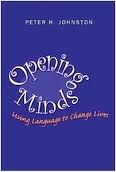
I have read and reread Choice Words by Peter Johnston and always come away with new learning and a-ha moments. It is a short book, but jam-packed with ideas that impact the language we use in our classrooms to build positive learning communities. Since reading Choice Words helped me see how powerful words can be and that our language is a powerful teaching tool, I was thrilled when Peter Johnston's new book Opening Minds was published. I was so excited to read it, that I immediately downloaded the e-Book version to avoid having to wait for the shipping. I have read the book twice so far and know that I will be rereading parts over and over again until I internalize the language.
My take-aways, thoughts, and reflections from the first three chapters of Opening Minds by Peter Johnston are:
Fixed Mindset vs. Growth Mindset:
I read and loved reading Mindset by Carol Dweck and shared the concept of fixed mindset vs. growth mindset with my students this year. It was so powerful to share the concept with students (click here to read more about how I shared it with students). I love how Peter Johnston discusses the important concept of mindset in Opening Minds and how it relates to the language we use in our classrooms with students. For example, when we say,"I'm not good at.." or "You are good at.." or "You are so smart at..." we are modeling fixed mindset attributes. Johnston explains in chapter one that saying someone is smart is just like saying someone is dumb and we would never use the word "dumb" when speaking to students. Changing our statements from "You must be smart" to "You must have worked hard" models a learning frame of mind rather than a fixed frame of mind. Instead of saying, "I'm not good at..." we need to use the word "yet" to emphasize the fact that we need to work hard and practice the skill to continue to grow as a learner.
"I'm not good at this yet."
This word is small in size but powerful in meaning. Using the word, "yet", is the difference between seeing intelligence as a fixed character trait and as something that grows with learning. By saying "yet", we are acknowledging the fact that we are in the learning process and are still working on strengthening this skill/strategy. I need to practice using this in the classroom when referring to myself because I have a habit of saying "I'm not good at drawing" when in fact I never practiced it in my life or even tried to because it never interested me. So instead of asking students to draw something because "I'm not good at drawing", I can say, "I'm not good at drawing this yet because I still need to practice." Our goal is for students to say, "I'm not good at this yet" and to take the necessary steps to change that. Yet is a key word and needs to be modeled and emphasized in our classrooms so it becomes internalized by our students and us.
"Our language choices have serious consequences for children's learning and for who they become as individuals and as a community (pg.7)."
Our language needs to show students that we believe things are changeable because if they can't be changed then working hard and practicing is pointless. We need to model and show students that working hard and trying helps us grow and change as learners in all areas. Learning is a process, not a fixed trait of being smart or dumb. To help increase students awareness of the learning process, we can ask, "How did you do that?" How did you figure that out?" These questions get students to think about their thought process and therefore the learning process. As teachers, we also need to model that making mistakes is part of the learning process and that it is okay to make mistakes because we learn from them. I love the line on page 3 when the teacher says, "I make mistakes just like you." She made it clear to her students that when you make a mistake, you fix it and learn from it. This is an important message to make clear in our classrooms to help create a safe learning environment where students feel safe to make mistakes, go out of their learning comfort zone, and take risks as learners to continue to grow.
I will be posting again for #cyberPD later this week about the next three chapters so stay tuned. Please visit the blogs linked at the beginning of this post to read more thoughts about this powerful book and to get linked to other blogs participating in #cyberPD. Thank you again to all of the organizers of #cyberPD :)
Happy Reading! :)
Subscribe to:
Posts (Atom)


