Saturday, May 4, 2013

Historical Fiction Book Club Unit: Part 1

Currently, we are in our Historical Fiction Book Club Unit and students are applying the skills/strategies they learned in our Social Issues Book Club Unit to this unit.  To launch the unit, we have been reading and discussing various historical fiction picture books, such as: Henry's Freedom Box by Ellen Levine and Kadir Nelson, Freedom Summer by Deborah Wiles, Freedom on the Menu:The Greensboro Sit-Ins by Carole Boston Weatherford, The Other Side by Jacqueline Woodson, and The Butterfly by Patricia Polacco. While reading these picture books, we have been thinking and talking about the time periods, historical conflicts, and how the characters' actions/choices are impacted by the groups they belong to as well as the time period.  As we read these picture books, we created charts as a class like we normally do during every read aloud (see photos of charts below).  

Students have been applying the skills/strategies they are learning through mini-lessons and read aloud to their historical fiction book club books that their group chose to read.  Each book club chose at least three books that either focus on one time period so they can become an "expert" on that time period or are reading books across different time periods and are reading them in sequence.  Most book clubs this year chose the latter and have planned out how to read their books in order according to the time periods.  Some of the books my book clubs are reading are: Behind the Bedroom Wall by Laura E. Williams, Stones in Water by Donna Jo Napoli , Countdown by Deborah Wiles, Number the Stars by Lois Lowry, Lily's Crossing by Patricia Reilly Giff, Elephant Run by Roland Smith, and many more.  

Below are photos of some of the charts we created as a class so far during this historical fiction unit: 
Historical Fiction Unit Chart with some Teaching Points 

 Read Aloud Chart for Freedom on the Menu
 Read Aloud Chart for Freedom Summer 

Read Aloud Chart for The Other Side 
Chart that shows our thinking across Historical Fiction Read Alouds 

Stay tuned to hear more about our unit and see more photos of student work too! Please share any ideas you have for historical fiction units too - I always love to hear about new titles, charts, and strategies to use during this unit! :)


Wednesday, May 1, 2013

Our Poetry Celebration and Students' Poetry Books

Last week, we had our class celebration to culminate our poetry unit.  We invited parents and family members to the cafeteria so students could spread out in small groups to share their poetry books with their audience.  During this unit, I always give each student a hard cover poetry book from Bare Books to create their very own poetry book with all the components of a published book: title, title page, dedication, table of contents, poems, illustrations/photos, about the author, and end pages.  The students were so excited to create their very own hard cover poetry book!  Students continued to use Google Drive during our poetry unit to type up their poems, share them, and get feedback just like they have been doing in all of our writing units.  After writing many poems, they began the decision making process of which poems they loved and wanted to publish in their book. Once they selected poems, they decided how to best illustrate the poems with either their own drawings or photos. Then the book-making process began!


Below are examples from some of the students' published poetry books: 
Examples of Poetry Book Covers and Titles
Examples of Back Covers of Poetry Books


Example of Title Page
Example of Table of Contents 

Another Example of Table of Contents


Happy Writing and Celebrating! :)


Tuesday, April 30, 2013

Sharing Our Writing Practices


On Tuesdays, Ruth and Stacey host Slice of Life on their blog at twowritingteachers.wordpress.com. Feel free to write, link, and/or comment!

On Friday, we hosted teachers and administrators from a neighboring school district who are considering implementing writing workshop in the fall. We have been an affiliate of Teachers College Reading and Writing Project for over ten years and at this point, our district's writing program is rooted in workshop practices.

Initially, we met in the conference room and went over the history, rationale, systems, and structures that we have in place. Because I work within these structures every day, I don't always think about the groundwork that had to happen in order for workshop to be such common practice in our district.

One of the principals wanted to know about getting teachers to buy in so we talked about how strongly we believe in the workshop approach. Beginning with those foundational beliefs is such a powerful way to bring people on board. Another visitor asked about explaining the workshop model to parents, another important component. Yes, parents do have to understand that their children's work won't be perfect and should not have adult corrections on it. "Adults don't write on students' work?" someone asked. I know that this is a mind shift for people adopting a workshop model, but no, adults do not write on students' work and parents, as well as classroom teachers, special education teachers, tutors, para-professionals, and any other adult working with student writers need to become aware of this.

Part of the visit included three classroom observations and we were all so impressed with the teaching and learning in the kindergarten, first and second grade classrooms. To see three classes in a row of different grades working on their writing is a powerful experience in and of itself--you see the development and progression of learners so clearly! To watch our visitors take in the independence, repertoire and sense of purpose that our young writers had was also powerful. Our teachers delivered their mini-lessons and then had time to answer questions and reflect on their practices because their learners are so programmed to work on their pieces and use available resources to cycle through the writing process. Our young writers were understandably proud of their work in progress and happy to share their challenges and inspirations with their visitors. I kept hearing people say that they couldn't believe the work that children were producing. I also heard our teachers repeatedly inviting our visitors from another district to take pictures, look at student work, read notebooks, and ask questions.

I am new to my position as the district's writing coordinator, so I can not take credit for the high commitment we have to the writing process and the workshop model, but I can be incredibly proud and excited to be a part of it. Additionally, I am proud to be a part of an educational community that opens its doors and classrooms to colleagues from a neighboring district. It was truly a great slice of life and a model for professional practice.


Monday, April 29, 2013

It's Monday! What Are You Reading?


On Mondays, Jen Vincent and Kellee Moye host What Are You Reading? on their blog, teachmentortext.com. If you are ever in need of a book recommendation, this is a guaranteed place to find some!

Over the course of the week, I have been reading samples of books from National Geographic that I picked up at the New England Convention for Social Studies. Because we are working on units that have to do with world geography, I zeroed in on the Global Issues Series. I can not recommend these books highly enough. There are twelve topics in the series, a total of 36 books since each topic has books written at three different reading levels. Some of the topics are globalization, food supply, energy resources, health, human rights, and several more. In addition to the Global Issues Series, they have also created products for many periods of American History that are well worth exploring, as the books are closely aligned with CCSS, they are engaging, and they have companion teacher texts.


The publishers have created parallel texts at three different grade levels. I have read them several times and the differences are subtle, but significant for the purposes of differentiation. Aside from the text, the books have open-ended comprehension questions and, in addition to the core knowledge, two case studies that are different in the grade level texts. For example, the fifth grade level of Water Resources focuses on different geographical areas that the 6/7 level text and the Level 8 text. I can envision study groups presenting topics as classroom experts. I strongly believe in challenging students to become activists and each book contains a page about what we can do to help (see the page on the left). These books also contain writing projects (see the page on the right) that are aligned to Common Core State Standards at whatever level the students are reading. National Geographic has developed books aligned to both science and social studies units. These books can serve as amazing mentor texts, as well as resources for engaging and relevant information for our middle grade learners. If you haven't seen them, you should definitely link over to the website, and check them out!

Happy Reading!


Thursday, April 25, 2013

Social Issues Book Club Unit Reflection

To read my previous posts on our social issues unit, please click below. 

After each unit of study, I have students reflect on their learning during the unit and think about which strategies/skills they can transfer and use in the next unit.  Before beginning our historical fiction unit this week in reading workshop, I had students reflect on our social issues unit.  I have been modeling and teaching students how to reflect on their learning since the beginning of the year so they have begun to internalize the reflection process which is such an important life skill for them to have as learners.  

To begin, I wrote three reflective questions on chart paper: 
  • Which strategies did you learn in this unit that were helpful? 
  • How did book club conversations help you as a reader? 
  • Which strategies/skills can you transfer and use in our historical fiction unit? 

Then we discussed one question at a time and I modeled how I might answer the question as a reader and then students turned and talked to share their personal responses.  All of our teaching points and strategy examples are on charts right near our meeting area so they were able to refer to those as they turned and talked to share their reflections verbally.  After discussing each question and giving students a chance to see me model answering the question and having a chance to turn and talk with their book club, students went off to write their reflections in their reader's notebook.  Each student has a section in their notebook for reflections.
Below are some examples of students' reflections:


I'd love to hear other ways students reflect at the end of units in reading and writing workshop so please share! We began our historical fiction book club unit this week so I will be posting about that unit so stay tuned. :)


Tuesday, April 23, 2013

Launching the Grade 1 Opinion Unit

Throughout the year, our school district has staff developers from Teachers College Reading and Writing Project come and work with our teachers. These days are always inspiring and full of learning! Yesterday, Christine Holley worked with our first-grade teachers to launch our new Opinion Writing unit. Some of the highlights of the day and my favorite comments were:

  • Pre-assessment is so important because you can see what the students know and don't know. Just  give them an open-ended prompt and see what they do with it. You will learn a lot about what they know!
  • "Ultimately, let's think about what is important and fun in conjunction with the (Common Core) Standards."
  • When you launch a new unit, you just want a lot of energy--you want kids to be really wanting to get to their seats and write! When Christine finished her mini-lesson in about 9 minutes, she did not give students elaborate, precise directions. Off you go is a favorite line from TC and when she said this, the students went off and evaluated, rated, and wrote about their collections for over 30 minutes.
  • Mini-lessons have become more balanced in the Writing Workshop with shares, conferences and strategy groups, other important learning opportunities. Christine used the share at the end of the workshop to make an important teaching point.
  • Inquiry lessons are gaining importance, as well, where students look at mentor texts and examine them for what makes them effective. Warning: If you have to do too much fishing for the "right" answer, then you probably are not ready for an inquiry lesson and you should return to direct instruction. Students have to know some things about the subject before they are ready to name the traits.
  • Whatever unit you are in, you are working on qualities of good writing and process. In any unit, are students planning, re-reading, learning about qualities of good writing? 
As part of the new Opinion Unit that will be described in detail in the new Units of Study writing books that should be released at the end of May, first-graders bring in collections and rate them before they get to writing. Christine taught the launch to our students in two classrooms and, I have to say, if the energy stays anywhere close to what it was yesterday throughout the unit, those children will be effective reviewers and evaluators by Memorial Day!

Happy writing,


Monday, April 22, 2013

It's Monday! What are You Reading?

Thank you Jen and Kellee for hosting this weekly!  To see what others are reading and recommending, or to participate, be sure to check out their blog Teach Mentor Texts :)

This past week was our April vacation so I was able to make a dent in my stack of books to read.  Below are some of the books I read this past week:


My class was very fortunate and lucky to win a signed copy of Lunch Lady and the Video Game Villain #9 by Jarrett Krosoczka before it was published! It comes out this week on store shelves so definitely pick up a copy.  I love the Lunch Lady books and have read them all so I was equally as excited as my kids in classroom to get my hands on this book to read.  Of course I had to sneak it to read it one night because it was always being read by one of the kids during the day - never made it to shelf in class library! The ending in this book leaves you in complete suspense so I can not wait till book #10 to find out what happens to Lunch Lady and Betty!


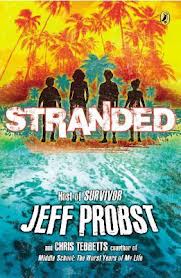
I also read Stranded by Jeff Probst and Chris Tebbetts.  One of my students, this year, loves the show Survivor so he was so excited to find out there was a new series out by the host. This is the first book in the series and it will hook reluctant readers who enjoy reading survival books and being in suspense. Along with the survival theme of the book, there are also social issues. The main characters are four kids who are now related by marriage, two from the mother and two from the father in a new blended family. The parents are on their honeymoon and the four kids are traveling on the uncle's boat together.   The goal of the trip is for the four kids to bond and begin to like each other or at least be civil to one another. While they are at sea, there is a huge storm that drastically changes their travel plans and the survival begins...

The Center of Everything by Linda Urban is a beautifully written book.  The main character, Ruby Pepperdine, is an 11 year old girl who is anxiously awaiting her twelfth birthday so she can have her wish come true as she reads her winning essay at the Bunning Day Parade in town. She is a superstitious girl who perseverates on things she has said or done in the past and has the "should have, could have" thoughts in her head. In particular she misses her grandmother Gigi and wants to relive the last moment she had with her before she passed away because she regrets the moment.  She is hoping that her wish will be granted on the day of the parade as she reads her winning essay.  The Bunning Day Parade is a town tradition and means a lot to her family and to her grandmother Gigi.  


Flying the Dragon by Natalie Dias Lorenzi is a powerful story about a young girl named Skye who was born and lives in the United States and her cousin Hiroshi who has always lived in Japan.  Skye's father is Japanese and lived in Japan until he married her mother and moved to the United States.  Since Skye has always lived in the U.S., she considers herself American and not Japanese.  In fact, she even changed her name from Sorano to Skye to "Americanize" it.  She eats American food and only speaks Japanese once in awhile when her father makes her, so it is pretty rusty.  There are big changes when Skye find out her grandfather, uncle, and cousin, who she has never met before, are moving to their neighborhood from Japan.  Her father has not seen or talked to them in years because of a family disagreement so he is excited to bond again with his family members.  Since they only speak Japanese, Skye must go to Japanese school on Saturdays to learn the language better so she can talk to her relatives.  As Skye is struggling to learn Japanese so she can be Hiroshi's translator at school, Hiroshi is struggling to learn English and to fit in to a brand new culture.  Both of them are not happy at all under the circumstances and at first take it out on one another.  However, they begin to have realizations and things begin to change... I love how this book rotates between a chapter from Skye's point of view to a chapter from Hiroshi's point of view.  That set-up really ties the book together nicely.

I also read the poetry book, This is Just to Say: Poems of Apology and Forgiveness by Joyce Sidman. I have had this book in my classroom library for years, but for some reason it slipped through the cracks and I never read it cover to cover.  I loved this book and can't wait to read it aloud to my class this week! I love how on one page there is an apology poem for an action and then on another page there is the forgiveness poem in reply to the apology - very clever poetry book! 
 Happy Reading! :)


It's Monday! What Are You Reading?


On Mondays, Jen Vincent and Kellee Moye host What Are You Reading? on their blog, teachmentortext.com. If you are ever in need of a book recommendation, this is a guaranteed place to find some!

Having been on vacation last week gave me a lot of time for reading and I was able to read some books that have been on my list.  I read Parvana's Journey and Mud City by Deborah Ellis, the second and third books of a trilogy that begins with The Breadwinner. These books tell the stories of fictional Afghani girls in the years just before 9/11. Although the accounts are incredibly sad, the events are appropriate for upper elementary and middle school students. My high school daughter read them as well since she was looking for a book to read and she had a lot of questions about the Taliban and events in the Middle East. She was angry at the sadness of the stories and the lack of closure, but appreciated the parallel of this uncertainty to the real-life events within this area of the world. Thank you to Tara for the recommendations.

I also read Between Shades of Grey by Ruta Sepetys, another extremely sad book about the plight of the Lithuanians during World War II. I have studied Hitler and the Holocaust, but was much less aware of the atrocities of Stalin and his deportation of millions of people from Lithuania, Latvia, and Estonia. This book is more appropriate for high school students or mature middle school readers since there will be some predictable questions about behavior of people in power. It's beautifully written and I am sure that the characters will stay with me for a long, long time.

Back to work today...Happy reading!